Best Thyroid Test: At-Home Kits vs Lab Panels Compared
How at-home thyroid kits compare with a build-your-own lab panel on markers, price, turnaround, and clinician follow-up.
- Published
- September 22, 2026
- Read time
- 15 min read
- Medically reviewed by
-
 Rhonda Collins, FNP-C
The best thyroid test is the one that measures the markers your question actually needs, at a price that includes every fee. Five options are compared here: four at-home kits and one build-your-own lab panel.
- Best overall and best value: Mito Health. TSH, free T4, free T3, and TPO antibodies together cost $32.97 as a member at Quest, draw fee included.
- Fastest results: LetsGetChecked. Innerbody measured a hands-on turnaround of 8 days.*
- Best for autoimmune screening and ongoing management: Paloma Health. Thyroid-specialist telehealth around the panel, at the slowest turnaround tested, 16 days.*
- Best straightforward one-time check: Everlywell. A familiar single panel with no program attached, priced between $99 and $149 depending on the source.*
- Best low-friction first test: myLAB Box. $125, finger-prick collection, and a free physician telemedicine consult if results come back positive.*
The cheapest kit is rarely the most complete panel. Marker sets and clinician follow-up vary more between these options than price does.
What a thyroid test actually checks
Four markers do most of the work in the products compared here: TSH, free T4, free T3, and TPO antibodies. Which of the four a product includes is the single biggest difference between the options below. They are not the whole of thyroid testing. Thyroglobulin antibodies, thyroid stimulating immunoglobulin, reverse T3, and thyroid imaging all answer questions these four cannot, and your doctor orders them when the clinical picture calls for it.
- TSH is the pituitary signal telling the thyroid to work harder. The American Thyroid Association describes it as the initial test for thyroid function in many situations.
- Free T4 is the unbound thyroxine available to your tissues. The American Thyroid Association explains that free T4 assessed alongside TSH adds information TSH alone does not carry.
- Free T3 is the unbound form of the more metabolically active hormone.
- TPO antibodies are immune antibodies against the enzyme the thyroid uses to make hormone.
The labeling distinction matters. “T4” and “T3” without the word “free” usually mean the total measurement, which includes hormone bound to carrier proteins and is not the same result. A product that reports total T4 with a T3 uptake and a calculated free thyroxine index is estimating what a direct free T4 measurement reports outright. When you compare two products, compare the exact assay names, not the panel names. For how the two free markers differ in practice, read free T3 vs free T4.
Antibody testing is what separates thyroid function screening from autoimmune screening. TSH, free T4, and free T3 describe how the gland is currently performing. Antibody markers describe whether the immune system is attacking it, and a panel carrying none of them cannot raise the autoimmune question at all.
TPO is the most commonly ordered of those antibodies, but it is not the only one, and a kit that includes it has not completed an autoimmune workup. Thyroglobulin antibodies are the usual companion marker for Hashimoto’s, and thyroid stimulating immunoglobulin is the marker specific to Graves’. Hashimoto’s vs Graves’ disease covers what each antibody pattern points to and why a full autoimmune panel usually reaches past TPO.
How the options compare
The five options below are grouped by the goal each one serves best, judged on four things a buyer can check before ordering: pricing transparency including fees, coverage of the four markers compared here, turnaround, and whether a clinician is available afterward.
Collection method is the other axis. Four of the five are self-collected at home and mailed to a lab. The fifth, Mito, is a venous draw at a partner site, which is why it can carry markers a small capillary sample cannot.
The table further down puts price, biomarkers, sample method, turnaround, and clinician follow-up side by side. The sections here carry the reasoning behind each placement.
Mito Health: best overall and best value
Mito does not sell a thyroid kit. It sells the individual tests, so you assemble the panel you actually want and members pay Mito’s cost for it. Mito makes its money on the $9 membership, not on the tests you order.
All four markers compared on this page, at Quest prices verified against the live catalog on September 22, 2026:
| Test | Member | Non-member |
|---|---|---|
| TSH | $3.51 | $4.92 |
| Free T4 | $3.94 | $5.52 |
| Free T3 | $7.02 | $9.83 |
| TPO antibodies | $3.50 | $4.90 |
| Quest draw fee, once per visit | $15.00 | $15.00 |
| Total | $32.97 | $40.17 |
The draw fee is charged once per visit, not per test, so adding markers to the same order does not add another fee. New York, New Jersey, and Rhode Island route to BioReference instead of Quest at different prices, and BioReference charges a $9.50 draw fee. Treat every figure here as a starting point and confirm the current price in the catalog before ordering.
Membership is $9 per month or $99 per year and is what unlocks member pricing. Every result is reviewed by a clinician before your analysis and action plan are finalized. A live 1:1 consult is a separate add-on at $39 for members and $99 for non-members.
The tradeoff is real: this is a venous draw at a Quest, Labcorp, or BioReference site, not a finger-prick at your kitchen table. You book a visit and go. If that is the deciding factor, one of the mailed kits below is the better fit even at several times the price.
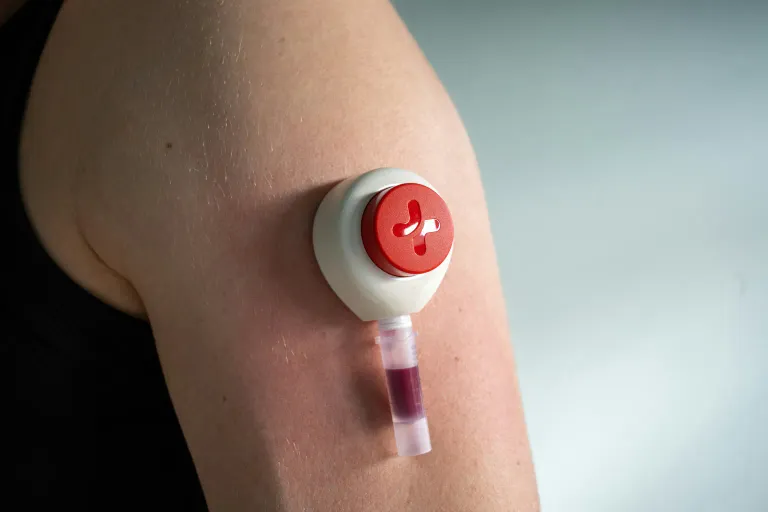
Mito has exactly one at-home thyroid option, and it is narrow. The At-Home Men’s Hormone and Thyroid Test Kit uses an upper-arm Tasso collector and carries TSH as its only thyroid marker, alongside cortisol, DHEA-S, estradiol, total and free testosterone, SHBG, albumin, and LH. It is $102.33 for members and $143.27 for non-members with no draw fee. It is a hormone kit that includes TSH, not a thyroid panel, and it does not replace free T4, free T3, or antibody testing. For more on how collection method changes what a sample can support, see the at-home blood draw guide.
LetsGetChecked: fastest results
LetsGetChecked is the speed pick. Innerbody’s hands-on testing measured a turnaround of 8 days, the fastest of the kits compared here.*
LetsGetChecked splits thyroid testing across two products rather than one. The Thyroid Test covers thyroid function, and the separate Thyroid Antibody Test covers the autoimmune question. They carry different biomarker counts and different prices, so check which one you are adding to your cart. If you want both function and antibodies, you are buying two products.
Collection is vial-based rather than a lancet-and-card system, which asks a little more of you at the kitchen table but yields a larger sample. Follow-up is nurse-led rather than doctor-led. A nurse call is a genuine service and more than most kits include, but it is not a physician consultation, and it is not the specialist access Paloma builds its product around.
For a wider comparison of Mito and LetsGetChecked beyond thyroid testing, see Mito Health vs LetsGetChecked.
Paloma Health: autoimmune and ongoing management
Paloma Health is the pick for people who already suspect or manage Hashimoto’s and want ongoing care rather than a single number.
The core Paloma panel covers all four markers compared here: TSH, free T4, free T3, and TPO antibodies.* Reverse T3 and vitamin D are available as add-ons.* It is the only single kit here confirmed to carry antibody testing alongside the three function markers, rather than selling antibodies as a second product.
What Paloma sells around the panel is the actual differentiator: doctor-led telehealth with thyroid specialists, an autoimmune protocol diet plan, a care manager, and a patient community.* If your next step after a result is a prescription, a dose adjustment, or a long-term plan, that ecosystem is worth more than a few dollars of panel price.
The tradeoff is time. Paloma had the longest turnaround among the competitors tested, at 16 days.* That is a poor fit for a one-off curiosity check and a reasonable one for care you intend to continue.
Everlywell: a straightforward one-time check
Everlywell is the recognizable option for someone who wants a single thyroid panel with no program attached to it.
Pricing is the complication. Sources disagree, putting the thyroid test somewhere between $99 and $149.* Innerbody specifically criticized a price increase that arrived without added value in the panel.* Check the price on Everlywell’s own site on the day you order rather than trusting any figure quoted elsewhere, including this one.
Be direct about the gap: no live clinician consultation for thyroid results is confirmed for Everlywell in the research behind this page. That is not a claim that none exists. It means the research does not establish one, while LetsGetChecked’s nurse call and Paloma’s specialist telehealth are both established. If talking to someone afterward matters to you, treat that as unverified rather than as included.
Everlywell suits a reader who wants a familiar brand, one panel, one result, and no subscription. For a broader head-to-head, see Mito Health vs Everlywell.
myLAB Box: a low-friction first test
myLAB Box is the low-friction entry point for a first-time tester, with real caveats attached.
The thyroid kit is $125 and uses finger-prick collection, the least demanding sampling method here.* If your results come back positive, myLAB Box includes a free physician telemedicine consult.* A consult that triggers only on a positive result is narrower than Paloma’s always-on care, but it is more than nothing at this price.
Two caveats deserve weight. First, the labeling is ambiguous about whether the T3 and T4 results are free or bound measurements.* As explained above, that is not a cosmetic difference, and an ambiguous label makes the result harder to compare against any future test. Second, Innerbody found turnaround creeping out to 12 days alongside weak customer support.*
Choose myLAB Box when a simple finger-prick and a low entry price matter more than knowing exactly which assay you bought.
Side-by-side comparison
| Option | Price | Thyroid markers | Sample method | Turnaround | Clinician follow-up |
|---|---|---|---|---|---|
Mito Health (build your own) | $32.97 member, $40.17 non-member, draw fee included | TSH, free T4, free T3, TPO antibodies | Venous draw at a partner lab | Not stated on this page | Clinician review of every result; 1:1 consult $39 member / $99 non-member |
| LetsGetChecked | Not restated* | Two products: thyroid function, and antibodies sold separately* | At-home vial collection* | 8 days* | Nurse-led* |
| Paloma Health | Not restated* | TSH, free T4, free T3, TPO antibodies; reverse T3 and vitamin D as add-ons* | At-home collection* | 16 days* | Doctor-led thyroid-specialist telehealth* |
| Everlywell | $99 to $149, varies by source* | Not restated* | At-home collection* | Not stated* | Not established in the research behind this page* |
| myLAB Box | $125* | T3 and T4 labeling ambiguous between free and bound* | At-home finger prick* | Up to 12 days* | Free physician telemedicine consult on a positive result* |
* Competitor pricing, biomarker lists, and turnaround times are as supplied in Mito’s source research brief dated September 22, 2026, and were not independently re-verified against provider sites for this page. Providers change pricing and panel contents without notice. Check the provider’s own site before ordering. “Not restated” means the brief did not supply a figure and none has been invented here. Mito’s own figures come from the live catalog on the same date and carry no asterisk. For per-test cost depth on thyroid markers, see the thyroid panel cost guide and the TSH test cost guide.
Why thyroid symptoms often point elsewhere
Fatigue, brain fog, cold sensitivity, and hair changes send a lot of people to a thyroid test, and a normal thyroid panel leaves them with the symptom and no explanation. Several common nutrient deficiencies produce an overlapping picture.
Low iron stores are the clearest example. The National Heart, Lung, and Blood Institute lists fatigue and weakness among the symptoms of iron-deficiency anemia, and ferritin is the marker that reflects stored iron. The NIH Office of Dietary Supplements describes fatigue and weakness as symptoms of vitamin B12 deficiency, and its vitamin D fact sheet describes fatigue and muscle weakness in vitamin D deficiency. Vitamin D deficiency is also common enough that it is worth checking rather than assuming.
None of that makes a thyroid test the wrong test. It makes a thyroid-only kit a narrow one. If your actual question is “why am I tired,” a panel that includes ferritin, vitamin D, and B12 alongside the thyroid markers answers more of it in a single draw, and it is worth asking your doctor which of those belong in your order. For a fuller walk through the differential, see how to diagnose brain fog.
How to choose
No symptoms and no diagnosis. Testing here is a judgment call rather than a recommendation. The US Preventive Services Task Force concluded that the evidence is insufficient to weigh the benefits and harms of screening nonpregnant, asymptomatic adults for thyroid dysfunction, and it names real harms: TSH varies enough to produce false positives, and abnormal TSH results can lead to overdiagnosis and overtreatment, because some mild or subclinical abnormalities later return to normal, do not progress, or never cause health problems. None of that applies to a diagnosed thyroid disorder, which needs the follow-up your doctor sets. So treat screening itself as a decision to make with your doctor against your own risk factors, not a box to tick. If you do test, the American Thyroid Association describes TSH as the initial measurement, with free T4 read alongside it.
Known or suspected autoimmune thyroid disease. You need antibodies, and you need somewhere to take the result. Note that TPO on its own is where an autoimmune workup starts, not where it ends: thyroglobulin antibodies usually accompany it for Hashimoto’s, and thyroid stimulating immunoglobulin is the marker for Graves’. No kit in this roundup carries TSI. Mito sells the TPO and thyroglobulin antibodies panel and TSI as separate line items you can add to the same draw, which is worth discussing with your doctor before you order. Paloma is built for ongoing autoimmune care: the four markers compared here plus thyroid-specialist telehealth.* Mito covers those same four for far less, with clinician review of the result and a $39 member consult, but it is not a thyroid specialty practice.
Tracking a medication dose. You will be testing repeatedly, so per-test price compounds. A member repeating TSH and free T4 pays a few dollars per marker plus one draw fee. Ask your prescribing clinician which markers and what interval fit your situation, and keep using the same lab so results stay comparable.
Budget first. Compare final totals, not sticker prices, and count fees, shipping, and whether antibodies are a separate purchase. Panel completeness and follow-up access outlast the price difference: a cheap result you cannot interpret and cannot act on is the expensive outcome.
Frequently asked questions
Is an at-home thyroid test as accurate as one my doctor orders?
Both run on samples analyzed in certified laboratories, and the assays are the same class of test. The differences that matter are the sample and the panel. A finger-prick or a mailed capillary sample is smaller and travels for days, while a venous draw is processed from a larger, fresher sample. And a kit that omits free T4 or antibodies cannot answer a question a fuller panel can, regardless of how accurate it is at what it does measure.
Can I use FSA or HSA funds?
For Mito, yes. Mito Health is HSA and FSA eligible through its Flex partnership, so you can pay with an HSA or FSA card. Coverage for the other providers depends on their own checkout, so check before ordering.
What does an abnormal result mean?
A single out-of-range value is a starting point, not a diagnosis. TSH in particular moves with illness, pregnancy, medication, and time of day, and one reading outside a reference range is commonly repeated before anything is concluded. Bring an abnormal result to your doctor, who can interpret it against your symptoms and history and decide whether to repeat it or test further.
How often should I retest?
There is no general interval that applies to everyone, and no evidence-backed case for putting a thyroid test on an annual repeat by default. What drives a retest is a reason: an abnormal or borderline previous result, new or persisting symptoms, a risk factor or family history your doctor is tracking, pregnancy or planning one, or thyroid medication. If you are starting or adjusting that medication, your prescribing clinician sets the interval, and it is usually far shorter than a year because the point is to see the effect of the change. Set the interval with your doctor rather than from a calendar.
The bottom line
If you want all four of the markers compared here for the least money, assemble them yourself. TSH, free T4, free T3, and TPO antibodies come to $32.97 as a Mito member at Quest with the draw fee included, against $99 to $149 for a kit,* where antibody testing is sometimes a separate purchase. The cost is a trip to a lab.
If mailing a sample from home is non-negotiable, the kit you want depends on your goal: Paloma for autoimmune and ongoing care, LetsGetChecked for speed, Everlywell for a familiar one-time check, and myLAB Box for the lowest-friction first test. Whichever you pick, read the exact assay names before you pay.
Medical disclaimer
This guide explains testing options and how to compare them. It does not interpret thyroid results or provide medical advice, diagnosis, or treatment. Prices, panel contents, fees, and availability change; confirm current details with each provider before ordering. Discuss your results and your testing needs with a qualified clinician.
Thyroid function tests
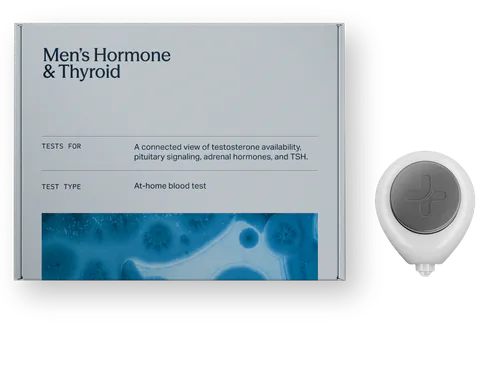
At-Home Men’s Hormone and Thyroid Test Kit
View current details, availability, and member pricing.
TSH Blood Test with Reflex to Free T4
The most sensitive first-line marker for thyroid function, behind fatigue, weight change, and mood shifts.
Triiodothyronine, Free (Free T3) Blood Test
The active thyroid hormone, most useful for confirming and pinpointing hyperthyroidism.
Free Thyroxine (Free T4) Blood Test
The unbound thyroid hormone actually available to your tissues, and the usual next step after an abnormal TSH.