Apple Watch and Garmin VO2 Max Accuracy: How Close Is Your Watch to a Lab Test?
How Apple Watch, Garmin and Whoop estimate VO2 max, what published studies found when they compared each watch with a lab test, and when the difference matters.
- Published
- October 30, 2026
- Read time
- 12 min read
- Medically reviewed by
-
 Rhonda Collins, FNP-C

Your watch estimates VO2 max. A lab test measures it. Apple Watch, Garmin and Whoop all work out a number from your heart rate, your movement and your profile, while a lab test analyzes the oxygen in your breath during an all-out effort. In the newest independent study, an Apple Watch Series 10 read about 6 mL/kg/min lower than a lab test on average, an average error of about 13%, and put only about 1 in 7 people in their correct fitness band. Small studies of Garmin watches found average errors under 10%, about 7% in two of them. We found no published study that checks Whoop’s VO2 max estimate against a lab test.
That makes a watch useful for watching your own trend on the same device. It is a weaker basis for training zones, for a baseline you plan to track for years, or for deciding which fitness band you are in.
How Apple Watch estimates VO2 max
Apple calls its VO2 max estimate Cardio Fitness. Apple Watch Series 3 and later record it during Outdoor Walk, Outdoor Run and Hiking workouts, using the watch’s heart and motion sensors [1]. The estimate also takes in your age, sex, weight, height and any medications you have entered that affect your heart rate. It can take at least 24 hours of wearing the watch plus several of those outdoor workouts before you see a first estimate [1]. Apple says the watch supports a range of 14 to 65 mL/kg/min and shows classifications for people 20 and older [1].
Apple’s 2021 technical paper explains the method. The watch does not wait for you to reach your peak. It predicts VO2 max from how your heart rate responds to a submaximal effort, such as a brisk walk or a run on fairly flat ground (less than a 5% incline or decline) [2]. That is why the number depends on a correct age, sex and weight in the Health app, and why medications that limit your heart rate need to be entered.
How accurate is Apple Watch VO2 max?
Three independent studies have compared Apple Watch with a lab test in which people exercised to their maximum while their breath was analyzed. All three found the watch read low on average, and all three found large errors for some individuals. Each study tested a different group and a different watch, so their figures are reported separately here.
Apple Watch Series 10 (2026). Researchers at University College Dublin gave 40 healthy adults an Apple Watch Series 10 running watchOS 11 and compared its estimate with a maximal treadmill test [3]. Of the 35 people included in the analysis, the watch read 6.25 mL/kg/min low on average. Its mean absolute error was 6.79 mL/kg/min, about 13.2% of the measured value. For individuals, the watch ranged from about 18 mL/kg/min too low to about 6 too high. It placed 5 of 35 people (14%) in their correct fitness percentile band, and another 12 within one band of it. The limits matter: the group was young (average age about 23, range 20 to 36) and mostly fit, with only 2 people at or below the 40th percentile, so the results may not hold for older or less fit people [3].
Apple Watch Series 9, Ultra 2 and earlier models (2025). The same research group tested 30 adults with an average age of about 32, most wearing a Series 9 or Ultra 2 and a few wearing older models, all on watchOS 10 or later [4]. The watch underestimated measured VO2 max by 6.07 mL/kg/min on average, with a mean absolute error of 6.92 mL/kg/min and an average percentage error of 13.3%. Here too most participants were highly fit, which the authors name as the study’s main limitation [4].
Apple Watch Series 7 (2024). A German study of 19 adults aged 18 to 63 compared the watch’s estimate, generated after an outdoor run, with a lab test on a stationary bike [5]. The watch estimated an average of 41.4 mL/kg/min against a measured 45.9, an average percentage error of 15.8%. Agreement between the two for individuals was poor (an intraclass correlation of 0.47). The authors found the watch tended to overestimate people with low fitness and underestimate people with excellent fitness [5]. With 19 people, this is the smallest of the three.
Apple’s own validation. Apple’s 2021 paper reported an average error of 1.4 mL/kg/min (standard deviation 4.7) in 221 people wearing Apple Watch Series 4, with an average age of 55 [2]. That figure is not directly comparable with the studies above. Apple’s reference value was itself projected from submaximal exercise tests to an age-predicted maximum heart rate, not measured at an all-out effort [2]. Apple’s group was also older and less fit than the young, fit groups in the independent studies.
How Garmin estimates VO2 max
Garmin watches show separate VO2 max estimates for running and cycling, with data from Firstbeat Analytics and ratings from The Cooper Institute [6]. For running, the watch needs wrist-based heart rate or a compatible chest strap, and an outdoor run with GPS of at least 10 minutes in which you reach at least 70% of your maximum heart rate. For cycling, it needs a power meter and a steady, high-intensity ride of at least 20 minutes. Garmin says the estimate may seem inaccurate at first because the watch needs a few runs or rides to learn your performance, and recommends completing your user profile and setting your maximum heart rate [6].
How accurate is Garmin VO2 max?
Published studies of Garmin watches are small, and several of them paired the watch with a chest heart rate strap rather than relying on the wrist sensor alone.
- Garmin fēnix 6 (2025). In 19 healthy adults who wore Garmin’s chest strap for a 10 to 15 minute outdoor run, the watch’s estimate had an average percentage error of 7.05% against a lab test [7]. The authors judged it accurate by their criteria.
- Garmin Forerunner 920XT (2019). In 24 healthy adults, this watch, which uses a chest strap, had an average percentage error of 7.3% and underestimated VO2 max [8]. It was the only device of the five tested to stay under 10% error, and the authors concluded that the devices they tested were most likely not accurate enough for sports or health care use.
- Garmin Forerunner 265 (2026). In 20 people training for a half marathon, the watch read higher than the lab test both before and after 12 weeks of training: 43.95 vs 41.10 mL/kg/min at the start and 45.00 vs 42.43 at the end. Its average percentage error stayed below 10% [9]. This study was published online ahead of print.
A 2025 systematic review found 13 validation studies of wearable VO2 max estimates. Most tested Garmin watches with chest straps and Firstbeat’s algorithm, and 7 of the 13 found the estimate valid or acceptable compared with a lab test [10]. The review called for longer studies that follow the same watches for months or years. An average percentage error near 7% is a group figure. On a measured VO2 max of 45 mL/kg/min it works out to about 3 mL/kg/min on average, and some people in each study were further off.
Is Whoop VO2 max accurate?
There is no published answer yet. A PubMed search on October 30, 2026 found no peer-reviewed study comparing Whoop’s VO2 max estimate with a lab test. Whoop researchers have published a large study that uses Whoop-derived cardiorespiratory fitness as an outcome [11], but it does not test the estimate’s accuracy against a measurement. Until an independent validation is published, treat a Whoop VO2 max as an unverified estimate, best used for your own trend.
Why watch estimates and lab results differ
A watch infers VO2 max from the relationship between your heart rate and how hard you are working, plus your profile data. A 2022 meta-analysis of 14 validation studies found that watches using exercise data were more accurate than those using resting data alone. Even so, the authors said the error for an individual is large, and that these estimates still need to improve for sport or clinical use [12].
Apple lists everyday reasons an estimate can drift [2]:
- a wrong age, sex or weight in your profile;
- carrying extra weight, such as a heavy backpack or a child, or walking on sand;
- pushing a stroller or using an assistive device;
- dehydration, caffeine, extreme heat, or a recent move to high altitude, which raise heart rate and can lead to underestimates;
- heart rate limiting medications that are not entered in the Health app;
- pregnancy.
Garmin’s estimate depends in the same way on a correct profile and maximum heart rate [6].
When the difference between a watch and a lab test matters
Setting training zones. A watch does not measure your aerobic or anaerobic threshold or your real maximum heart rate. A lab VO2 max test does, and zones built from your own thresholds fit you better than zones built from an age formula. Our zone 2 heart rate guide shows how far the formulas can be off.
A baseline you will track for years. If you want to see how your fitness changes with training or with age, an error of 6 mL/kg/min is bigger than many real changes. A measured starting point is more reliable, and repeat tests are most useful on the same type of machine.
Borderline fitness bands. If your watch puts you near the line between two bands for your age and sex, the Series 10 study suggests the band may well be wrong: the watch got it right for only 1 in 7 people [3].
When your watch disagrees with how you feel. If the number seems far off, check your profile first, then consider a lab test. Our guide to raising your VO2 max for healthspan covers what to do with the number once you trust it.
When a watch trend is enough
For many people, the watch is enough. If you want to know whether your fitness is rising or falling, compare your watch with itself: the same device, the same kind of workout, the same kind of route, over weeks and months. Apple’s paper reported good test-retest consistency for its estimates (an intraclass correlation of 0.86 in its validation group, measured 28 or more days apart) [2], although that has not been checked independently. The independent studies tested accuracy at one point in time, not how well the watch tracks change. Read a single number as a rough guide and the direction over months as the more useful signal.
How a lab VO2 max test measures it
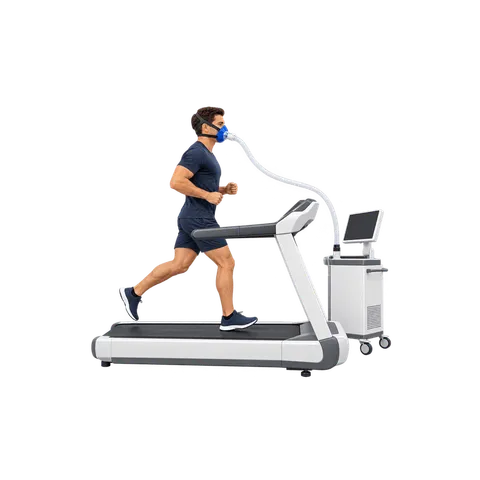
A lab VO2 max test measures the oxygen you use directly. You wear a mask that analyzes your breath while the effort increases on a treadmill or a bike until you reach your peak [2]. The same test finds your aerobic and anaerobic thresholds, your measured maximum heart rate and your heart rate recovery.
Mito offers the VO2 Max Test at partner testing centers. You enter your ZIP code to find a center, answer a one-minute safety check, then book, and your report appears in your Mito dashboard next to your lab results. What the report includes is covered in introducing the VO2 Max Test at Mito, and prices across providers are in our guide to VO2 max testing near me and what it costs. A VO2 max test is a fitness test, not a cardiac stress test. If you get chest pain, fainting or unusual breathlessness when you exert yourself, see your doctor rather than booking a fitness test.
Frequently asked questions
Why is my Apple Watch VO2 max so low?
In the independent studies, Apple Watch read low on average, by about 4.5 to 6 mL/kg/min, and most of those participants were fit. A wrong age or weight in the Health app, carrying a load, heat, caffeine or dehydration can also pull the estimate down.
Is Garmin or Apple Watch more accurate for VO2 max?
No published study has tested both against a lab test in the same people. Separate small studies found average errors of about 7% for some Garmin watches, several used with a chest strap, and about 13% to 16% for recent Apple Watch models, so the designs are too different to name a winner.
Can Apple Watch show a VO2 max above 65?
No. Apple says Apple Watch supports a VO2 max range of 14 to 65 mL/kg/min, so a very fit person whose measured value is higher would still see 65 at most.
Does wearing a chest strap make a Garmin VO2 max estimate more accurate?
Garmin’s watches accept either wrist heart rate or a chest strap. The Garmin studies with the lowest errors used a chest strap, but none compared strap and wrist readings head to head.
Can a smartwatch replace a lab VO2 max test?
For watching your own trend, often yes. For a measured value, your thresholds, your real maximum heart rate or training zones, no: a watch estimates VO2 max and a lab test measures it.
References
- Apple Support: Track your cardio fitness levels
- Apple: Using Apple Watch to Estimate Cardio Fitness with VO2 max, May 2021
- Lambe R, et al. Accuracy of VO2 max Estimates From Apple Watch Series 10. Mayo Clin Proc Digit Health 2026
- Lambe R, et al. Investigating the accuracy of Apple Watch VO2 max measurements: A validation study. PLoS One 2025
- Caserman P, et al. Assessing the Accuracy of Smartwatch-Based Estimation of Maximum Oxygen Uptake Using the Apple Watch Series 7: Validation Study. JMIR Biomed Eng 2024
- Garmin: Forerunner 965 Owner’s Manual, About VO2 Max. Estimates
- Carrier B, et al. Validation of Aerobic Capacity (VO2max) and Pulse Oximetry in Wearable Technology. Sensors 2025
- Passler S, et al. Validity of Wrist-Worn Activity Trackers for Estimating VO2max and Energy Expenditure. Int J Environ Res Public Health 2019
- Howard J, et al. Validity of the Garmin Forerunner 265 to predict VO2max and race performance times. J Med Eng Technol 2026
- Železnik Mežan L. Accuracy of wearables for determining the maximal oxygen uptake and lactate threshold: a qualitative systematic review. Front Sports Act Living 2025
- Holmes KE, et al. Four core circadian behaviors that improve cardiorespiratory fitness through consistent sleep. Sleep 2026
- Molina-Garcia P, et al. Validity of Estimating the Maximal Oxygen Consumption by Consumer Wearables: A Systematic Review with Meta-analysis and Expert Statement of the INTERLIVE Network. Sports Med 2022
Tests discussed in this guide
Measures your aerobic fitness from your breath and finds your heart rate training zones.