
Fertility Blood Tests for Women: Which Test Answers Which Question
AMH, FSH, estradiol, progesterone, LH, prolactin, and TSH each answer a different fertility question, and several only make sense on the right cycle day. Here is what each one shows, when to draw it, and what no blood test can tell you.
- Published
- September 30, 2026
- Read time
- 13 min read
- Medically reviewed by
-
 Rhonda Collins, FNP-C

Table of contents
Fertility blood tests for women measure hormones, and each one answers a narrower question than “am I fertile?” AMH estimates your remaining egg supply and can be drawn on any day. FSH and estradiol are read together early in your cycle, on days 2 to 4. Progesterone confirms that you ovulated and is drawn about a week before your next expected period. Prolactin and TSH look for hormone problems that can disrupt ovulation. None of them can check your fallopian tubes, your uterus, the quality of your eggs, or your partner’s sperm, which is why a full fertility evaluation also includes imaging and a semen analysis [1].
What “fertility testing” can and cannot mean
“Fertility test” is used for two different things. One is a hormone snapshot you order on your own, usually to learn about ovulation or egg supply before you start trying or while you are planning. The other is the infertility evaluation a clinician runs when pregnancy has not happened. That evaluation looks at three areas: whether you ovulate, whether your uterus and fallopian tubes are open and normally shaped, and a semen evaluation of the male partner [1].
Blood tests cover only the first area and part of the background. The American College of Obstetricians and Gynecologists (ACOG) [2] lists four things blood tests can measure in a basic workup: progesterone (to see if you ovulated), thyroid function, prolactin, and ovarian reserve (egg supply).
Which fertility blood test answers which question
This map lists each hormone test, the question it answers, and when in the menstrual cycle to draw it. Cycle day 1 is the first day of menstrual bleeding.
| Test | Question it answers | When to draw it |
|---|---|---|
| AMH (anti-Müllerian hormone) | Roughly how large is my remaining egg supply (ovarian reserve)? | Any cycle day |
| FSH (follicle-stimulating hormone) | How hard is my brain signaling the ovaries? Part of ovarian reserve. | Early follicular phase, cycle days 2 to 4, together with estradiol |
| Estradiol (E2) | Is an early-cycle FSH result reliable? How active are the ovaries? | Early follicular phase, cycle days 2 to 4, together with FSH |
| Progesterone | Did I ovulate this cycle? | About 1 week before your next expected period |
| LH (luteinizing hormone) | Is my ovulation signal working? Read with FSH. | With FSH, since the two are read as a pair; urine kits track the surge |
| Prolactin | Is a high prolactin level disrupting ovulation? | No set cycle day; stress and exercise can raise it |
| TSH (thyroid-stimulating hormone) | Is a thyroid problem affecting my cycle? | No set cycle day |
The timing for AMH, FSH, estradiol, and progesterone comes from the American Society for Reproductive Medicine (ASRM) [1, 3]. For timing rules on tests unrelated to fertility, such as iron and lipids, see whether you can do a blood test during your period.
AMH: your egg supply, on any day
Anti-Müllerian hormone (AMH) is made by the cells around small, early follicles in the ovaries, so it tracks how many eggs remain. Because AMH does not depend on the monthly hormone swings, it stays fairly steady within and between cycles and can be measured at any point in the menstrual cycle [3]. ASRM describes AMH as a more sensitive measure of ovarian reserve than FSH, and notes that it tends to decline before FSH rises.
AMH is also read in two other contexts. A high AMH can be one sign of PMOS, although AMH alone cannot diagnose it, and a low AMH can suggest that menopause is approaching without predicting when it will happen [4]. AMH needs no special preparation. For what AMH results mean at different ages, see the AMH biomarker guide. Order the test on its own as an AMH blood test.
FSH and estradiol: read together, early in the cycle
Follicle-stimulating hormone (FSH) is the pituitary signal that makes eggs mature. When fewer eggs remain, the body produces more FSH to push the ovaries. FSH changes across the month, so it is only meaningful as a fertility marker when drawn at a set time. ASRM advises measuring basal FSH and estradiol together in the early follicular phase, between cycle days 2 and 4 [1].
Estradiol matters here mostly as a check on FSH. ASRM says estradiol alone should not be used to screen ovarian reserve, and that its value is in correctly interpreting a normal FSH: an early rise in estradiol can suppress FSH and make a low reserve look normal [3]. That is why an FSH result without an estradiol result from the same draw is hard to read.
In women whose periods have stopped, the same pair helps tell two situations apart. High FSH with low estradiol points toward ovarian insufficiency. Low or normal FSH with low estradiol points toward hypothalamic amenorrhea [1].
Mito offers both as separate lab-draw tests: FSH and estradiol. Book them for the same morning between cycle days 2 and 4.
Progesterone: confirming ovulation a week before your period
Progesterone rises after an egg is released, so a luteal-phase progesterone test is how a blood test confirms that ovulation happened. The timing is the whole test. ASRM advises drawing it about 1 week before the expected start of your next period, rather than on a fixed day such as day 21, because cycle lengths vary [1]. ACOG [2] gives the same window. Day 21 only lines up with that window in a 28-day cycle. In a 35-day cycle, the right draw is closer to day 28.
ASRM treats a progesterone level above 3 ng/mL as presumptive evidence of recent ovulation. Because luteal progesterone can swing sevenfold within a few hours, a single value can confirm ovulation but cannot judge the quality of the luteal phase. ASRM also notes that women with regular cycles of 21 to 35 days generally do not need extra testing to confirm ovulation, unless they have excess hair growth (hirsutism) [1]. Order it as a progesterone test.
LH: the ovulation trigger, best tracked in urine
Luteinizing hormone (LH) surges just before ovulation and triggers the release of the egg. For timing sex, the useful measure is the surge, and that is what home urine ovulation kits detect. A positive urine result suggests ovulation in the next 24 to 48 hours [2].
A single blood LH test answers a different question. It is read alongside FSH, and LH that stays high through the month in someone of childbearing age can point to a condition affecting the ovaries, such as PMOS, primary ovarian insufficiency, or thyroid or adrenal disorders [5]. Because an LH blood test is interpreted alongside FSH, it is simplest to draw the two together.
Prolactin and TSH: ruling out hormone problems that block ovulation
Prolactin is the hormone that drives breast milk production, and high levels can disrupt ovulation [2]. ASRM does not recommend prolactin as a routine test for everyone. It is indicated when periods are infrequent or absent, or when there is milk discharge outside pregnancy or breastfeeding [1]. Small increases can come from stress, exercise, sex, a high-protein diet, and some medicines, so a mildly high result is often repeated before anything else [6]. See the prolactin test.
Thyroid-stimulating hormone (TSH) screens for an underactive or overactive thyroid. ASRM notes that thyroid disorders found by TSH can impair fertility when untreated, and that an abnormal TSH warrants free T4 and thyroid antibody testing [1]. An underactive thyroid can also raise prolactin, which is one reason the two are often checked together [6]. See the TSH test.
Ovarian reserve is not the same as your chance of pregnancy
A low AMH or a high FSH does not mean you cannot get pregnant, and a normal result does not mean you will. ASRM states that ovarian reserve markers measure egg quantity, not egg quality, and are poor predictors of reproductive potential independent of age [3]. In one prospective study ASRM cites, women aged 30 to 44 without known infertility who had low AMH or high FSH had similar cumulative pregnancy rates after 6 and 12 cycles of trying as women with normal results.
ASRM’s position is that these markers should not be used as a fertility test for women who are not infertile or have not yet tried to conceive, and that age is a much stronger predictor of success than ovarian reserve. Where AMH does help is in planning. ACOG describes AMH as a useful, if imperfect, measure of egg quantity for people who plan to delay childbearing and may want to talk with a reproductive endocrinologist [7].
What fertility blood tests cannot tell you
A full set of normal hormone results still leaves most of the fertility picture unchecked. Blood tests cannot assess:
- Your fallopian tubes. Blocked tubes are an important cause of infertility and are checked with imaging such as hysterosalpingography (an X-ray dye test) or a contrast ultrasound [1].
- Your uterus. Polyps, fibroids, and scarring inside the uterus are found with transvaginal ultrasound, saline ultrasound, or hysteroscopy, not bloodwork.
- Egg quality. There is no standardized method to measure egg quality [7]. AMH counts quantity only.
- Endometriosis and pelvic adhesions. Laparoscopy is the only method for a specific diagnosis of these factors [1].
- Your partner. The most common cause of male infertility is a problem with sperm, which is assessed with a semen analysis [2]. When there is a male partner, ASRM recommends evaluating both partners in parallel.
How birth control, PMOS, and thyroid disease change the results
Hormonal birth control. Combined pills, patches, and rings work mainly by stopping ovulation [8]. While you use them, a progesterone test cannot confirm natural ovulation, and early-cycle FSH and estradiol do not reflect your own cycle. AMH can still be measured, but ASRM notes that AMH may be lower in women currently using hormonal contraceptives and should be interpreted with caution [3].
PMOS. PMOS (polyendocrine metabolic ovarian syndrome) is one of the most common causes of irregular or absent ovulation [1]. It can shift several markers at once: a high AMH can be one sign of it, and LH and prolactin can both run high [4, 5, 6]. None of these alone diagnoses PMOS. With irregular periods, a progesterone draw is hard to time because the next period is hard to predict. ASRM recommends evaluating for PMOS when FSH and estradiol are normal in someone with infrequent periods or no ovulation. For the full panel, see blood tests for PMOS.
Thyroid disease. An underactive or overactive thyroid can disturb the cycle, and untreated thyroid disorders can impair fertility (ASRM 2021). Because hypothyroidism can raise prolactin, a high prolactin result is easier to interpret when TSH is checked too.
At-home kit or lab draw
Every single-hormone test in this article is a lab-draw test: you order it, then have blood drawn at a partner lab. That matters for fertility testing, because it lets you choose the day. You can book FSH and estradiol for cycle days 2 to 4 and progesterone for about a week before your next period in the same cycle.
Mito also offers an at-home women’s hormone test kit. It uses a Tasso+ collector on your upper arm to collect a small capillary blood sample, with no venipuncture. It measures FSH, LH, estradiol, progesterone, prolactin, total testosterone, DHEA-S, and free T4. For fertility questions, know its limits:
- No AMH. It does not include the one fertility marker that works on any day.
- No TSH. It includes free T4 without TSH, so it is not a complete thyroid check.
- One collection day. A single sample cannot be both an early-follicular FSH and estradiol result and a mid-luteal progesterone result. Pick the question you most want answered and collect on the day that fits it, recording your cycle day on the form.
Frequently asked questions
How do I test if I’m fertile as a woman?
No single test confirms fertility. A blood test can show whether you ovulate (progesterone about a week before your period), estimate your egg supply (AMH on any day, or FSH with estradiol on days 2 to 4), and rule out thyroid or prolactin problems. A clinician’s evaluation adds imaging of the uterus and tubes and a semen analysis for a male partner.
How can I test my fertility levels?
“Fertility levels” usually means AMH and FSH, which measure ovarian reserve, the number of eggs remaining. They describe quantity, not your chance of getting pregnant this year, which depends much more on age [3].
What are the first signs of infertility?
The defining sign is not getting pregnant after 12 months of regular sex without birth control, or 6 months at 35 or older. Some signs justify an evaluation right away: irregular or absent periods, cycles shorter than 25 days, bleeding between periods, known or suspected endometriosis or tubal disease, known male-factor problems, and past chemotherapy or radiation [1].
At what age are 90% of your eggs gone?
Well before menopause. ACOG estimates about 1 to 2 million eggs at birth, 300,000 to 500,000 at puberty, about 25,000 at age 37, and about 1,000 at age 51 [7]. By those figures, more than 90% of the eggs present at puberty are gone by the late 30s. Egg quality also declines with age, and no blood test measures it.
When to see a fertility specialist
ACOG and ASRM use the same age and time thresholds for starting an infertility evaluation [1, 2]:
- Under 35: after 12 months of trying without pregnancy.
- 35 or older: after 6 months of trying.
- Older than 40: ACOG advises talking with an ob-gyn about an evaluation now, and ASRM says more immediate evaluation may be warranted.
- Any age, right away: if you have a condition known to affect fertility, such as irregular or absent periods, known endometriosis, or past cancer treatment.
An ob-gyn usually does the first assessment, and you may then see a reproductive endocrinologist, an ob-gyn with specialty training in infertility [2]. According to ACOG, most evaluations are finished within a few menstrual cycles. If you bring hormone results you already have, note the cycle day each was drawn on and whether you were using hormonal birth control.
Your next step
If you want one fertility-related number you can get on any day, start with an AMH test, and read it as a measure of egg supply rather than a verdict on fertility. If your question is whether you ovulate, time a progesterone test for about a week before your next period. If your cycles are irregular, pair FSH and estradiol on days 2 to 4 with TSH and prolactin, and take the results to your clinician.
References
- ASRM: Fertility evaluation of infertile women: a committee opinion (2021)
- ACOG: Evaluating Infertility
- ASRM: Testing and interpreting measures of ovarian reserve: a committee opinion (2020)
- MedlinePlus: Anti-Müllerian Hormone Test
- MedlinePlus: Luteinizing Hormone (LH) Levels Test
- MedlinePlus: Prolactin Levels
- ACOG: Anticipatory Counseling Regarding Ovarian-Factor Fertility Decline
- ACOG: Combined Hormonal Birth Control: Pill, Patch, and Ring
Women’s hormone tests
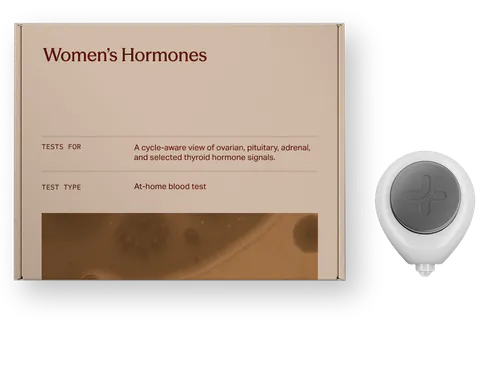
At-Home Women’s Hormone Test Kit
View current details, availability, and member pricing.
Estradiol (E2), Ultrasensitive Blood Test
Reads estrogen accurately at the very low levels found in men, postmenopausal women, and children.
Follicle-Stimulating Hormone (FSH) and Luteinizing Hormone (LH) Panel
The two pituitary hormones that drive ovulation, sperm production, and the reproductive timeline.
Sex Hormone-Binding Globulin (SHBG) Blood Test
The transport protein that decides how much of your testosterone and estradiol is actually available to tissues.