VO2 Max Test: How It Works, How to Prepare and What Your Report Shows
What happens during a lab VO2 max test, step by step, how to prepare, who needs a doctor's clearance letter first, and what the report includes.
- Published
- October 30, 2026
- Read time
- 8 min read
- Medically reviewed by
-
 Rhonda Collins, FNP-C

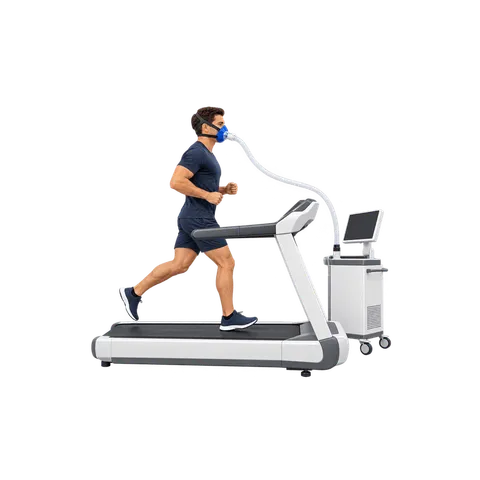
A VO2 max test measures the most oxygen your body can use during all-out exercise. You run on a treadmill or ride a stationary bike while the speed, incline or resistance rises every few minutes. You wear a mask over your nose and mouth that analyzes every breath, plus a heart rate monitor. The test ends when you can’t keep going, usually after about 8 to 15 minutes of hard effort. The whole visit takes 1 to 1.5 hours once you count setup and cool-down.
This guide covers how the test works, how to prepare, who needs a clearance letter from their doctor first, and what the report shows. Mito offers the VO2 Max Test at partner centers nationwide.
What is a VO2 max test?
A VO2 max test is a graded exercise test with gas analysis. “Graded” means the effort climbs in steps or a steady ramp. “Gas analysis” means a metabolic cart measures how much oxygen you breathe in and how much carbon dioxide you breathe out, through a mask connected to gas and flow sensors [1][2]. From those numbers it calculates your oxygen use at every stage of the test. Your VO2 max is the highest value you reach, in milliliters of oxygen per kilogram of body weight per minute (mL/kg/min).
This is the direct way to measure VO2 max. Smartwatches and fitness apps estimate it instead, from your heart rate and pace during workouts. An estimate can be useful for following trends, but it is not a measurement of the oxygen you use.
Clinicians run a fuller version of the same test, called cardiopulmonary exercise testing, to investigate unexplained breathlessness or heart and lung disease [2]. The American Heart Association has recommended that cardiorespiratory fitness be assessed routinely in clinical practice, as a clinical vital sign [3]. A fitness VO2 max test is not a cardiac stress test, though. It is not designed to diagnose or rule out heart disease.
How to test VO2 max, step by step
The exact routine varies by center, but a VO2 max test at a Fitnescity Health partner center, where Mito’s tests are done, follows the same broad sequence [1]:
- Check in. You fill in any paperwork the center needs before staff take you to the testing area.
- Get fitted. Staff fit the mask over your nose and mouth and attach a heart rate monitor, usually a strap.
- Warm up. You start at an easy walk, jog or light pedaling. Clinical testing guidance describes a few minutes of easy warm-up before the effort starts to climb [2].
- Work up to your limit. The treadmill speed or incline, or the bike’s resistance, goes up in steps or a steady ramp. Breathing gets harder, then very hard. Clinical protocols aim for about 10 minutes of rising effort, give or take 2 minutes [2].
- Stop. The test is limited by how you feel: it ends when you signal that you can’t continue [1]. Staff also follow standard exercise-testing rules for stopping early [2], so tell them right away if you feel chest pain, dizziness or anything that worries you.
- Cool down. You keep moving gently or rest for a few minutes while your heart rate recovery is tracked [1].
Whether you test on a treadmill or a bike depends on the center. The two are not interchangeable: treadmill tests use more muscle and tend to produce a higher peak oxygen uptake than bike tests [2]. If you plan to retest, do it on the same type of machine so the numbers compare fairly.
How to prepare for a VO2 max test
Preparation matters because food, fatigue and dehydration can all change how hard you can push. The instructions for VO2 max tests at Fitnescity Health partner centers [4]:
- Don’t exercise for 24 hours before your appointment.
- Come hydrated and well fed.
- Skip heavy meals for 2 to 3 hours before the test. A lighter snack is fine.
- Wear the clothes and shoes you would normally exercise in.
- Leave children at home. Staff can’t look after them while you test.
- Tell the front desk that you are booked for a test with Fitnescity Health.
- Arrive no more than 5 minutes before your appointment time, so the center can limit how many visitors are there at once.
- Block 1 to 1.5 hours. The appointment length varies, so allow time for setup and cool-down as well as the test itself.
Who needs a doctor’s clearance first?
Through Mito, a one-minute safety check before you pay decides whether you need a clearance letter from your own doctor. You need one when two or more of these apply to you:
- chest pain or discomfort
- lightheadedness, dizziness or fainting
- shortness of breath
- a rapid heartbeat
- smoking
- high blood pressure
- diabetes
- high cholesterol
- a heart or lung problem
- a bone, joint or muscle problem
- a mother, grandmother or sister who had a heart attack or died suddenly before age 65
- a father, grandfather or brother who had a heart attack or died suddenly before age 55
- your age: 45 or older for men, 55 or older for women
If you need a letter, the test center confirms your appointment only after it has received it. The test is not done during pregnancy. Details on how to send a letter are on the VO2 Max Test page.
That safety check is the test center’s own screen. It is not the American College of Sports Medicine (ACSM) screening process, which stopped counting risk factors in 2015. ACSM’s current recommendations instead weigh three things: how active you are now, whether you have known heart, metabolic or kidney disease, and whether you have symptoms that suggest one [5]. The symptoms ACSM lists are [5]:
- pain or discomfort in the chest, neck, jaw or arms, at rest or during activity
- shortness of breath at rest or with mild exertion
- dizziness or fainting
- shortness of breath when lying flat, or waking up breathless at night
- ankle swelling
- palpitations or a racing heartbeat
- calf pain when walking that eases with rest
- a known heart murmur
- unusual tiredness or shortness of breath during usual activities
Under ACSM’s recommendations, people with any of these symptoms should get medical clearance before starting or continuing an exercise program [5]. A VO2 max test is maximal exercise, so if any of them apply to you, see your doctor before booking, whatever the safety check says.
What does a VO2 max test report show?
A VO2 max test measures more than one number. Fitnescity Health describes its results as your oxygen use and heart rate at the start of the test, at your aerobic threshold, at your anaerobic threshold and at your maximum, plus your heart rate recovery 2 minutes after you stop [1].
- VO2 max. Your peak oxygen use in mL/kg/min. The report compares it with people of your age and sex.
- Aerobic threshold. The point where you move into the aerobic training zone, with your heart rate at that point [1]. The VO2 Max Test page describes that heart rate as the top of your zone 2.
- Anaerobic threshold. The point where effort becomes hard to sustain and you start relying more on carbohydrate for fuel, again with your heart rate [1].
- Max heart rate. Your highest heart rate, measured at your peak rather than estimated from an age formula.
- Heart rate recovery. How far your heart rate falls in the minutes after you stop [1].
The Mito report also lists your METs and arrives in your Mito dashboard, usually within 24 hours, per the VO2 Max Test page. Because the thresholds are measured, they are the best basis for training zones. Our zone 2 heart rate guide covers how to use them, and our guide to improving VO2 max covers what to do with the number.
For prices and where to test near you, see our guide to VO2 max test costs.
Frequently asked questions
Does a VO2 max test hurt?
There are no needles, but the last few minutes are very hard by design, because the test only works if you push to your limit. You can stop at any time.
Can I do a VO2 max test if I’m not fit?
Yes. The test starts easy and climbs from wherever your fitness is, so it measures your current level rather than demanding a set pace. If two or more items on the safety check apply to you, you need a clearance letter from your doctor first.
Can I drink coffee before a VO2 max test?
The test center’s instructions do not mention caffeine. They ask you to come hydrated and well fed and to avoid a heavy meal in the 2 to 3 hours before.
How often should I retest my VO2 max?
Retest after a training block of 8 to 12 weeks to see progress, or once a year to track your fitness. Use the same type of machine each time, because treadmill and bike results differ.
Mito’s launch announcement for the VO2 Max Test explains how the test fits with your lab results and membership plan.
Photo by Maico Amorim on Unsplash.
References
- Fitnescity: VO2 Max Testing (archived October 25, 2023)
- Glaab T, Taube C. Practical guide to cardiopulmonary exercise testing in adults. Respiratory Research, 2022
- Ross R, et al. Importance of assessing cardiorespiratory fitness in clinical practice: a case for fitness as a clinical vital sign. American Heart Association scientific statement. Circulation, 2016
- Fitnescity Health: test protocols, retrieved September 29, 2026
- Riebe D, et al. Updating ACSM’s recommendations for exercise preparticipation health screening. Medicine & Science in Sports & Exercise, 2015
Fitness tests discussed in this guide
Measures your aerobic fitness from your breath and finds your heart rate training zones.
Resting Metabolic Rate (RMR) Test
Measures the calories you burn at rest from your breath, not a calculator's guess.

Measures your body fat, lean muscle and visceral fat, region by region, in about 10 minutes.