Introducing the VO2 Max Test at Mito: Measure Your Fitness and Find Your Training Zones
Mito now offers a lab VO2 max test. It measures your aerobic fitness from your breath during a short, hard effort on a treadmill or bike, finds your own heart rate training zones, and puts the report in your Mito dashboard.
- Published
- October 28, 2026
- Read time
- 8 min read
- Medically reviewed by
-
 Rhonda Collins, FNP-C

Table of contents
Mito now offers the VO2 Max Test. It measures your VO2 max, the most oxygen your body can take in and use during all-out exercise, from your breath during a short, hard effort on a treadmill or bike. The same test finds your aerobic and anaerobic thresholds, your real maximum heart rate and your heart rate recovery, so you can set training zones from your own body. You order online, book a partner center near you, and see your report in your Mito dashboard next to your lab results.
The test costs $178.20 for Mito members (membership is $9/month) and $249.48 without membership. There is no separate center or order fee, and you can pay with your HSA or FSA card.
Why we added a VO2 max test
Cardiorespiratory fitness is one of the strongest signals of long-term health that you can actually change [1]. The American Heart Association has argued that it should be checked regularly, like blood pressure, as a clinical vital sign [1]. Most people never get it measured.
Many people already have a VO2 max number on their wrist. Smartwatches estimate it from your heart rate and pace during workouts. A lab test measures it. In a study of 40 healthy adults who did a lab treadmill test and then used an Apple Watch Series 10, the watch read about 6 mL/kg/min low on average, a mean absolute error of about 13%, and placed only about 1 in 7 people in their correct fitness percentile band [2]. A watch is useful for day-to-day trends. It is a weak basis for a training plan or a long-term baseline.
Blood tests describe what drives your health. A VO2 max test describes what your heart, lungs and muscles can do together at full effort. With the VO2 Max Test, that number sits in your Mito dashboard beside your labs.
What a VO2 max result helps you do
See where your fitness stands. Your report compares your VO2 max with people of your age and sex. Fitness and survival are closely linked. In a study of 122,007 adults who had treadmill tests at the Cleveland Clinic, people with below-average fitness for their age and sex had about 41% higher adjusted risk of death over a median of 8.4 years than people with above-average fitness. In the same study, that gap was about the same size as the gap linked with smoking or with diabetes [3]. This is an association: fitness in that study was estimated from treadmill performance, and the study shows fitness and survival moving together, not that raising your number will lengthen your life.
Train by your own zones. The test finds the heart rates where your effort shifts from easy to hard. Your aerobic threshold marks the top of zone 2, and your anaerobic threshold sets the floor for tempo and interval work. Your maximum heart rate is measured at your real peak rather than estimated from 220 minus your age, so the zones fit you. Our zone 2 heart rate guide shows what the age formulas estimate and how far off they can be.
Measure a training block. Test before and after 8 to 12 weeks of training to see what changed. VO2 max varies a little from test to test even when nothing has changed. In a small study of trained adults who repeated the treadmill test 8 to 20 times over 2 to 4 weeks, results varied by about 5.6%, almost all of it normal biological variation [4]. That is why a change of more than about 5% between tests is a better sign of real progress than day-to-day noise.
Hold on to fitness as you age. VO2 max falls with age. In the Baltimore Longitudinal Study of Aging, peak oxygen use fell by about 3% to 6% per decade in people in their 20s and 30s, and by more than 20% per decade from the 70s on [5]. A baseline now gives you something to compare against later. For training ideas, read our guide to raising your VO2 max at any age.
Who the VO2 Max Test is for
The test is for adults 18 and older who want a measured fitness baseline, for example if you:
- train for endurance and want zones set from your own thresholds;
- want to check what your watch is telling you;
- are starting a new training plan and want a before-and-after measurement; or
- want to track your fitness as part of a longer-term plan for healthy aging.
Who it isn’t for
- You get chest pain, fainting or unusual breathlessness when you exert yourself. See your doctor first. This is a fitness test, not a cardiac stress test, and it can’t check your heart for disease.
- You’re pregnant or might be. The test is an all-out effort, and partner centers don’t test during pregnancy.
- An injury stops you from running or cycling hard. The result depends on pushing to your limit, so wait until you can.
How it works with Mito
- Check eligibility and order. Answer the one-minute safety check, then check out on Mito. You don’t need a referral: a physician’s order is arranged for you when one is needed. If your answers mean you need sign-off from your own doctor first, you’ll know before you pay.
- Book your time. In your Mito dashboard, enter your ZIP code, choose a partner center and pick two preferred times. The center confirms one of them, usually within hours.
- Do the test. Staff fit a mask and a heart rate strap, and you warm up. Then the speed, incline or resistance rises every few minutes. After about 8 to 15 minutes of steadily harder effort, you stop when you can’t continue, then cool down while your recovery is tracked. Whether you use a treadmill or a bike depends on the center.
- Get your report. Results usually arrive within 24 hours, and officially within 2 business days. They land in your Mito dashboard, next to your labs.
- Train and retest. Set your zones from your thresholds. Retest after 8 to 12 weeks of training, or once a year, on the same type of machine.
Preparation is simple. You don’t need to fast. Don’t exercise for 24 hours before. Come well hydrated and fed, but avoid a heavy meal in the 2 to 3 hours before; a light snack is fine. Wear the clothes and shoes you normally exercise in, and allow 1 to 1.5 hours for the visit. There are no needles and no radiation.
What your report shows
| Measure | What it tells you |
|---|---|
| VO2 max | The most oxygen your body used at peak effort, in mL/kg/min. The number to track. |
| Aerobic threshold | The oxygen use and heart rate where easy, steady effort ends. The top of your zone 2. |
| Anaerobic threshold | The oxygen use and heart rate where effort becomes hard to sustain. |
| Max heart rate | Your highest heart rate, measured at your peak instead of estimated from your age. |
| Heart rate recovery | How far your heart rate falls 1 and 2 minutes after you stop. |
| METs | Your effort in multiples of your resting energy use, from the start to your peak. |
Your VO2 max is compared with people of your age and sex. With membership, your report also feeds your personalized action plan, so your fitness result is read alongside your bloodwork rather than in isolation.
VO2 max is expressed per kilogram of body weight, so a change in weight moves the number too. A DEXA body composition scan shows whether a change came from fitness or from body composition. If you want to know how many calories you burn at rest, the Resting Metabolic Rate (RMR) Test uses the same kind of breath analysis while you lie still.
What the VO2 Max Test can’t tell you
- It isn’t a cardiac stress test. It can’t diagnose or rule out heart disease.
- Your result depends on effort. Stopping early gives a lower number than your true maximum.
- Treadmill and bike results differ. Bike results usually run a little lower, so retest on the same type of machine.
- Small changes are noise. Changes of less than about 5% between tests are within normal test-to-test variation.
What it costs
| Option | Price |
|---|---|
| Mito member | $178.20, plus the $9/month membership |
| Without membership | $249.48 |
| Center or order fee | None |
The test is done at partner centers nationwide. Insurance rarely covers a VO2 max test because it is an elective fitness test, so plan to pay out of pocket. You can pay with your HSA or FSA card at checkout. You don’t need a Mito membership to buy the test: it lowers the price for $9 a month.
References
- Ross R, et al. Importance of Assessing Cardiorespiratory Fitness in Clinical Practice: A Case for Fitness as a Clinical Vital Sign. A Scientific Statement From the American Heart Association. Circulation 2016
- Lambe R, et al. Accuracy of VO2 max Estimates From Apple Watch Series 10. Mayo Clin Proc Digit Health 2026
- Mandsager K, et al. Association of Cardiorespiratory Fitness With Long-term Mortality Among Adults Undergoing Exercise Treadmill Testing. JAMA Netw Open 2018
- Katch VL, et al. Biological variability in maximum aerobic power. Med Sci Sports Exerc 1982
- Fleg JL, et al. Accelerated longitudinal decline of aerobic capacity in healthy older adults. Circulation 2005
Frequently asked questions
Is a VO2 max test the same as a cardiac stress test?
No. The VO2 Max Test is a fitness test. It measures how much oxygen your body can use at peak effort, and it can't diagnose or rule out heart disease. If you get chest pain, fainting or unusual breathlessness when you exert yourself, this test is not the right next step.
Will I need my own doctor's clearance?
Most people won't. The one-minute safety check before checkout tells you if you need clearance. If you do, your own doctor signs off first, and your appointment is confirmed once that sign-off has been reviewed.
Can I pay with my HSA or FSA?
Yes. The VO2 Max Test is HSA/FSA eligible. Select "Pay with HSA/FSA" at checkout to pay with your HSA or FSA card.
Does insurance cover a VO2 max test?
Rarely. A VO2 max test is an elective fitness test, so plan to pay out of pocket. You can still use HSA or FSA funds.
Can I book a DEXA scan and a VO2 max test on the same day?
Yes. Eat a light meal about 4 hours before your appointment, then drink only water. The DEXA scan is done first and the VO2 max test right after. Avoid exercise for 24 hours before.
Can I reschedule or cancel my appointment?
Yes, from your Mito dashboard. Your first two reschedules are free when you make them more than 24 hours before your confirmed appointment. Cancelling 24 hours or less before, or missing the appointment, forfeits the purchase.
Can I talk to someone about my results?
Yes. You can book a consultation from your Mito dashboard to go through your results and what they mean for your training.
Tests discussed in this post
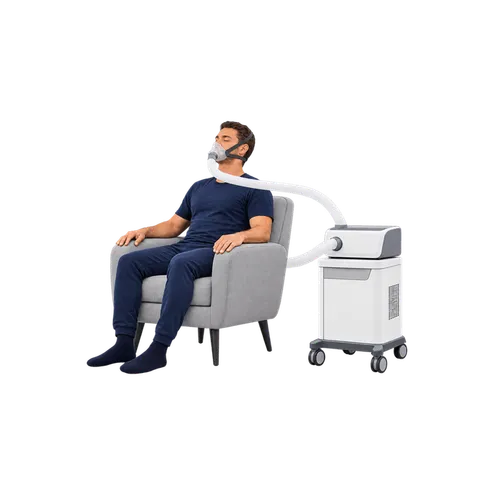
Resting Metabolic Rate (RMR) Test
Measures the calories you burn at rest from your breath, not a calculator's guess.

Measures your body fat, lean muscle and visceral fat, region by region, in about 10 minutes.