Best Supplements for Dark Circles: 10 Picks Ranked by Evidence
The right pick depends on what's causing the shadow. Iron, B12, vitamin D, vitamin C, and 6 more, ranked by evidence with form, dose, and the biomarker to test before you buy.
- Published
- May 7, 2026
- Last updated
- September 22, 2026
- Read time
- 20 min read
Quick Summary
There is no single “best supplement for dark circles.” There is a best supplement for your dark circles, and which one wins depends on what is casting the shadow: low iron, low B12, low vitamin D, dehydrated thin skin, or excess melanin in the periorbital area. Buy the wrong one and nothing changes. Buy the right one and you can see the difference in 8 to 12 weeks.
This guide ranks 10 supplements by how much evidence they have for fading dark under-eye circles specifically, not for general wellness. Each pick is paired with the form to take, the dose range, and the biomarker to check before you spend a cent.
Test first. Supplement second. That order is non-negotiable.
Why Topicals Alone Fail
You have tried the eye creams. You have tried the cold spoons, the cucumber slices, the concealer. The dark circles are still there every morning, and no topical product has moved the needle because the problem was never on the surface.
The periorbital skin is the thinnest skin on your body, roughly 0.5 mm thick compared to 2 mm elsewhere on your face. That means anything happening beneath the surface (pooled blood, broken capillaries, low hemoglobin, depleted collagen) shows through immediately. Dark circles are one of the earliest visible signs of nutritional deficiency, poor sleep, or systemic inflammation. They are a window, not a wall.
Retinol creams and peptide serums can modestly improve skin thickness over months, and a topical niacinamide serum has real evidence for pigment-driven darkness (covered later in this guide). But if your dark circles are driven by a ferritin of 15 ng/mL or an omega-3 index of 3 percent, no cream will close that gap. The most effective approach is inside-out correction of the deficiency or imbalance, with topicals as a secondary layer.
How We Ranked These 10 Supplements
Every supplement in this guide is scored against the same five criteria. No affiliate logic, no “as featured in” filler.
- Mechanism strength: is there a plausible biological reason this would help under-eye darkness, or is the connection wishful?
- Clinical evidence: peer-reviewed trials or systematic reviews specific to periorbital pigmentation, anemia-driven pallor, or skin hydration.
- Biomarker testability: can you measure whether you actually need it before buying?
- Form quality: is there a bioavailable, well-tolerated form that beats the cheap default?
- Cost-to-benefit: are you paying $5 a month or $40 a month, and does the evidence justify the spend?
Anything ranked top 4 hits at least 4 of the 5 criteria. Anything in the conditional 6 wins on one or two and is included only because the search intent is “what supplements help dark circles” and the answer would be incomplete without them.
What Color Is Your Dark Circle? 4 Root Mechanisms
Before picking a supplement, identify which mechanism is producing the discoloration. The color and texture of the circle is usually the strongest first clue, and most people fall into one or two dominant drivers.
What you see | Likely mechanism | Primary driver | Test these biomarkers |
|---|---|---|---|
Bluish-purple circles, pale inner eyelids, fatigue on stairs | Iron deficiency, low hemoglobin | Reduced oxygen delivery to periorbital tissue | |
Dark brownish-purple discoloration, sometimes a visible halo | Vascular fragility, capillary leakage | Blood pooling, hemosiderin deposits in dermis | Vitamin K status, vitamin C |
Translucent appearance with visible veins, “tired” look | Collagen loss, skin thinning | Loss of dermal thickness from age, UV exposure, or poor protein status | Vitamin C, collagen precursors |
Puffiness with darkening, worse after poor sleep or stress | Chronic inflammation, oxidative stress | Systemic inflammatory load, cortisol dysregulation |
There is also a genetic and structural component. Deeper-set eyes, thinner skin, and tear-trough anatomy are inherited traits that amplify any of the above. Supplements cannot change bone structure, but they can address every modifiable driver on this list.
Most people land in one of the first two rows. Iron deficiency is by far the most common nutritional driver, particularly for women of reproductive age, vegetarians, and endurance athletes. Vascular fragility is the second most common, especially in adults over 40. If you see yourself in row three or four, work the matching markers first before stacking iron and B12 (the supplements that show up in nearly every dark-circle product).
Quick Decision Tree - Choose Your Supplement in 30 Seconds
Match your situation to the row. The right supplement starts here.
- Pale skin, fatigue, heavy periods, or low energy on stairs? Test ferritin first. If it’s low, ferrous bisglycinate is the form typically used, in the 25-50 mg elemental-iron range
- Vegan, vegetarian, age 50+, or on metformin/PPIs? Test B12 first, then methylcobalamin 1,000-2,000 mcg daily
- High-latitude city, indoor job, or rarely outside before noon? Test 25-OH vitamin D, then D3 2,000-4,000 IU daily with K2
- Already supplementing iron and absorption seems slow? Add vitamin C 250-500 mg with each iron dose
- Asian, olive, or Fitzpatrick IV-VI skin with chronic darkness? Topical niacinamide 4-10% serum twice daily, not oral
- Thin or “crepey” under-eye skin that looks dehydrated? Oral hyaluronic acid 120-240 mg daily for 12 weeks
- Every lab is normal and circles still won’t fade? Likely structural (genetics, fat-pad atrophy, vascular). Skip oral supplements
- Already tried 3+ bottles with no result? Stop buying. Run a full panel before the next purchase
- Pregnant, nursing, or on prescription medication? Confirm dose with your physician before starting anything below
If two rows describe you, start with whichever marker tests lowest, not whichever supplement is on sale.
Why Test Before Buying
Most “best supplements for dark circles” lists skip the part that decides whether anything will work: the cause. Periorbital hyperpigmentation is not one condition. A 2021 systematic review identified at least four distinct mechanisms, including pigment accumulation, vascular pooling, structural shadowing from tear-trough anatomy, and post-inflammatory changes [1]. Each mechanism responds to a different intervention, and only some of them respond to oral supplements at all.
Three nutrient deficiencies have the strongest link to visible darkening or pallor that reads as darkening: iron, vitamin B12, and vitamin D [2,3,4]. Correct one of these when you actually have it, and the change is real and measurable. Correct one you do not have, and the bottle is decoration.
Every recommendation below pairs the supplement with the biomarker that tells you whether it can help. If the biomarker is in range, the supplement is unlikely to do anything for your circles, regardless of how the marketing reads.
The 10 Supplements - At-a-Glance Comparison
The full ranked set, before the deep dives.
Supplement | Best For | Dose | Evidence | Cost / Month |
|---|---|---|---|---|
Iron (Ferrous Bisglycinate) | Confirmed iron or ferritin deficiency | 25-50 mg elemental daily | Strong | $5-10 |
Vitamin B12 (Methylcobalamin) | Vegans, age 50+, low B12 panel | 1,000-2,000 mcg daily | Strong | $5-10 |
Vitamin D3 | Insufficient or low sun exposure | 2,000-4,000 IU daily | Strong (indirect) | $3-6 |
Vitamin C | Pair with iron, support collagen | 250-500 mg with iron | Moderate (supportive) | $2-5 |
Niacinamide (B3) | Pigment-driven darkness, IV-VI skin | Topical 4-10%; oral 500 mg | Moderate (topical) | $15-25 |
Oral Hyaluronic Acid | Thin or dehydrated under-eye skin | 120-240 mg daily | Emerging | $20-40 |
Vitamin K2 (MK-7) | Pair with vitamin D3 | 100-200 mcg daily | Limited (oral) | $5-10 |
Multivitamin (bioavailable) | Multiple confirmed low markers | One daily with meal | Indirect | $8-15 |
Omega-3 (EPA/DHA) | Inflammatory-pattern circles, puffiness | 2-3 g EPA/DHA daily | Moderate (inflammation) | $15-30 |
Astaxanthin | Photoaged or translucent circles | 4-12 mg daily | Emerging (skin) | $15-30 |
One caveat on the ranking. The evidence column scores effect on under-eye darkness specifically, not general nutritional value. A bioavailable multivitamin is a fine product and vitamin K2 has real cardiovascular and bone data behind it. They just are not targeted dark-circle interventions, which is why they sit at the bottom of this list and not the top.
The Top 4 - Evidence-Backed Picks
These four are the ones worth buying when the right biomarker confirms you need them.
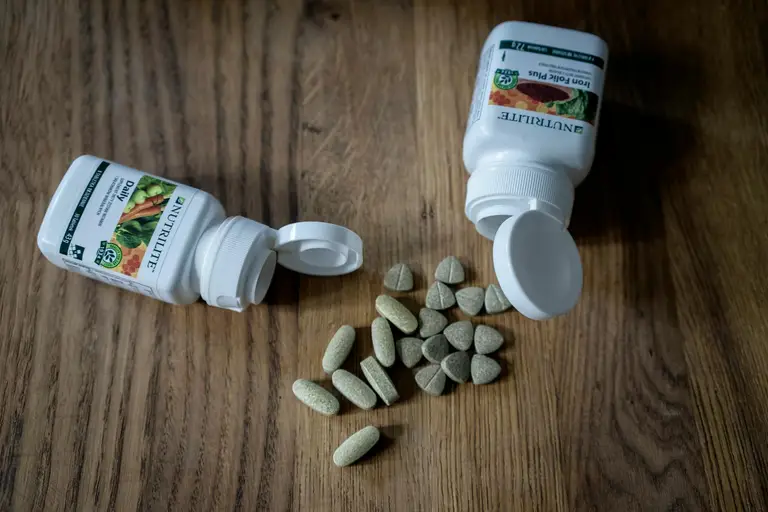
1. Iron (Ferrous Bisglycinate) - The First Thing to Test
Iron deficiency is the most common nutrient deficiency in the world, and it is the single most evidence-backed cause of visible under-eye darkening that supplements can fix [2]. The chain is mechanical: low iron, low hemoglobin, paler skin, the dense capillary network under the thin under-eye skin shows through more, the contrast reads as a shadow. Restore iron, the pallor lifts, the contrast softens.
Why ferrous bisglycinate beats the cheap forms:
- Equal absorption to ferrous sulfate at roughly half the GI side effects
- Around 20% elemental iron, well-tolerated even on an empty stomach
- Works across the full deficiency range, from mild (ferritin 20-50 ng/mL) to moderate (ferritin under 20 ng/mL)
Dose by severity:
- Mild deficiency: 25 mg elemental iron daily
- Moderate deficiency: 50 mg elemental iron, taken every other day for better absorption
- Severe deficiency (ferritin under 12 ng/mL): work with a clinician, oral may not be enough
Take it on an empty stomach with vitamin C if you can tolerate it. If you cannot, take it with a small low-calcium meal. Coffee, tea, calcium, and antacids cut absorption hard, so space them at least two hours away from your iron dose.
Test first: serum ferritin, hemoglobin, and transferrin saturation. Without these you are guessing, and excess iron is genuinely harmful, not “well, it just gets excreted.” For form-by-form tradeoffs across all six iron supplements, see our complete iron supplement comparison guide. For timing, food interactions, and the every-other-day protocol, see how to take iron supplements.
Cost: $15-25 for a 90-day supply.
2. Vitamin B12 (Methylcobalamin) - The Hidden Pallor Driver
B12 deficiency causes a slower, often-missed kind of anemia (megaloblastic) that produces pallor, fatigue, neurological symptoms, and in some cases visible skin hyperpigmentation [3]. The 2013 Cutis case series describes B12 deficiency as a recognized but routinely under-diagnosed cause of skin darkening that resolves with replacement therapy.
Who is at meaningful risk:
- Vegans and vegetarians (B12 occurs naturally only in animal foods)
- Adults over 50 (absorption declines with age and intrinsic-factor changes)
- Anyone on metformin, PPIs, or H2 blockers (these reduce B12 absorption)
- People with celiac, Crohn’s, or pernicious anemia
- Heavy drinkers
Why methylcobalamin over cyanocobalamin: it is the body-ready active form. Cyanocobalamin is cheaper but requires conversion, and a meaningful slice of the population converts it poorly. For most people the practical difference is small. For someone with genuine deficiency, the active form delivers a faster, cleaner correction.
Dose: 1,000-2,000 mcg daily, sublingual or oral. For confirmed deficiency, your physician may prescribe injections.
Test first: serum vitamin B12. Under 200 pg/mL is deficient, 200-300 pg/mL is borderline, and methylmalonic acid (MMA) is the more sensitive marker if your B12 sits in the borderline zone but symptoms persist.
Cost: $10-20 for a 60-day supply.
3. Vitamin D3 - The Cascade Behind the Cascade

Vitamin D does not directly pigment your skin, but it drives a cluster of secondary effects that worsen under-eye shadows: poor sleep architecture, low mood, persistent fatigue, and in severe cases anemia [4]. The 2007 NEJM review by Holick estimated more than a billion people worldwide are insufficient or deficient, and most of them have no idea.
Why D3 (cholecalciferol) over D2:
- Raises 25-hydroxyvitamin D more efficiently per IU
- Better tolerated, longer half-life
- Pair with vitamin K2 (MK-7) to direct calcium toward bones rather than soft tissue
Dose by status:
- Maintenance (level above 30 ng/mL): 1,000-2,000 IU daily with a meal
- Insufficient (level 20-30 ng/mL): 2,000-4,000 IU daily for 12 weeks, then retest
- Deficient (level under 20 ng/mL): clinician-supervised loading dose, often 50,000 IU weekly for 8 weeks, then maintenance
Take it with a fat-containing meal. Vitamin D is fat-soluble; on an empty stomach absorption drops sharply.
Test first: 25-OH vitamin D. Target 40-60 ng/mL.
Cost: $8-15 for a 90-day supply.
For deeper context on dosing edge cases, see vitamin D supplements: how much should you really take?.
4. Vitamin C - The Absorption Multiplier
Vitamin C earns its top-4 place by doing two supporting jobs well, not by directly fading shadows. First, it can roughly triple non-heme iron absorption when taken with an iron supplement. Second, it supports collagen synthesis, which is what keeps under-eye skin firm rather than thin and translucent [5]. The 2021 Nutrients review by Doseděl and colleagues covers both mechanisms in detail.
How to use it:
- 250-500 mg with each iron dose to boost ferrous bisglycinate absorption
- Or 500-1,000 mg daily for general collagen and skin support
- Skip mega-doses above 2,000 mg. The body cannot store vitamin C, the excess is excreted, and high doses can cause GI upset and (over time) increase oxalate kidney-stone risk
Form: ascorbic acid is fine for most people. If it bothers your stomach, switch to buffered ascorbate or liposomal C.
Cost: $5-12 for a 90-day supply.
The Conditional 6 - Use Only When the Top 4 Don’t Apply
The next six supplements have weaker, narrower, or topical-only evidence. They are worth knowing about so you do not buy them by mistake or skip them when they actually fit.
5. Niacinamide (Vitamin B3)
The strongest niacinamide evidence is topical, not oral [6]. A 2021 mechanistic review by Boo found nicotinamide reduces melanin transfer between melanocytes and keratinocytes and supports skin barrier function, which is why it shows up in nearly every serum marketed for hyperpigmentation. Oral niacinamide may help systemically, but the data is thin compared to topical.
If your dark circles are pigment-driven (more brown than purple, fairly even tone, often associated with Asian, olive, or Fitzpatrick IV-VI skin), a topical 4-10% niacinamide serum applied morning and night is the better-evidenced path. A 2024 systematic review of treatments in Fitzpatrick IV-VI skin types reinforces this exact point [8].
Dose: topical serum 4-10% twice daily. Oral 500 mg daily as a secondary option.
Cost: $15-25 monthly for a quality serum.
6. Oral Hyaluronic Acid
A 2023 randomized double-blind trial in Skin Research and Technology found oral hyaluronic acid 120 mg daily improved skin hydration, elasticity, and wrinkle depth over 12 weeks [7]. Effect on under-eye darkness was not directly measured, but improved hydration of thin under-eye skin is a plausible mechanism for softer-looking shadows. Treat the evidence as emerging rather than settled.
Dose: 120-240 mg daily for at least 12 weeks. Anything shorter and you cannot judge whether it worked.
Cost: $20-40 monthly. The most expensive supplement in this guide, and the one with the thinnest direct evidence for the indication.
7. Vitamin K2 (Pair Only)
Most periorbital vitamin K evidence comes from topical formulations, not oral supplements. Oral K1 and K2 support bone and cardiovascular health but have limited direct data for under-eye darkness. If you are already supplementing oral vitamin D3, pairing with K2 (MK-7 100-200 mcg) is sensible for systemic reasons. Do not expect it to fade circles by itself.
Cost: $5-10 monthly. Often bundled with D3, which is the cheapest way to buy it.
8. Multivitamin (Only If Confirmed Multi-Deficient)
A general multivitamin only earns a place when you have confirmed two or more low markers and want to cover them with one product instead of three bottles. If you go this route, pay for bioavailable forms:
- Methylfolate, not folic acid
- Methylcobalamin, not cyanocobalamin
- D3, not D2
- Bisglycinate or amino-acid-chelated minerals
- Iron-free if you are male or post-menopausal (most men do not need supplemental iron)
Skip “hair, skin, and nails” gummies. Most are under-dosed, sugar-loaded, and over-priced for what they actually deliver.
Cost: $8-15 monthly for a credible bioavailable multi.
9. Omega-3 (EPA/DHA) - For Inflammation-Driven Darkness
If your dark circles fit the inflammatory pattern (puffy lower lid, periorbital swelling, worse after stress or short sleep), omega-3 deficiency is a plausible contributor. EPA and DHA have a well-documented anti-inflammatory effect systemically. A 2011 cardiovascular review documents the consistent anti-inflammatory effect of marine omega-3 across trials, with measurable hsCRP reduction at 2-3 g EPA/DHA daily [9]. Whether that lower inflammatory load also calms periorbital microcirculation specifically has not been directly studied. It is a plausible extension of the same mechanism, not a proven one.
How to use it:
- Form: Triglyceride or re-esterified triglyceride fish oil (better absorbed than ethyl ester). Algal omega-3 if you avoid fish.
- Dose: 2-3 g combined EPA/DHA daily, with the largest meal of the day
- Duration: 12 weeks before reassessing; retest omega-3 index at 3 months and target 8-12 percent
- When to skip: omega-3 index already above 8 percent, or you eat 2-3 servings of fatty fish per week
Cost: $15-30 monthly for a quality third-party-tested fish oil. See our complete omega-3 supplement comparison guide for fish oil vs krill vs algal tradeoffs.
10. Astaxanthin - The Antioxidant for Periorbital Skin
Astaxanthin is a carotenoid antioxidant with roughly 100x the radical-scavenging capacity of vitamin E. Clinical trials show oral astaxanthin improves skin moisture, elasticity, and visible signs of photoaging at 6-12 mg daily over 8-16 weeks [10]. Direct evidence for under-eye darkness specifically is more limited, but the mechanism (oxidative stress reduction plus capillary microcirculation support) overlaps with the inflammatory and translucent dark-circle patterns.
How to use it:
- Form: Natural astaxanthin (Haematococcus pluvialis source) softgels. Synthetic astaxanthin has weaker evidence.
- Dose: 4-12 mg daily with a fat-containing meal (carotenoids are fat-soluble)
- Duration: 8-16 weeks before assessing visible change
- When to skip: If your dark circles are clearly iron-deficiency-driven (bluish-purple with fatigue), astaxanthin will not address the root cause. Treat iron first.
Cost: $15-30 monthly for a quality natural astaxanthin product.
Who Each Pick Is Best For
A faster way to map yourself to the right pick.
- You: heavy menstrual cycles, vegetarian, fatigue on stairs. Best pick: iron (ferrous bisglycinate), test ferritin first
- You: vegan or vegetarian for 2+ years, or over 50, or on metformin. Best pick: B12 methylcobalamin, test serum B12 and MMA first
- You: live above 35 degrees latitude, indoor job, dark skin tone. Best pick: vitamin D3 with K2, test 25-OH vitamin D first
- You: already on iron, ferritin still climbing slowly. Best pick: vitamin C with each dose
- You: brown-toned circles, Fitzpatrick IV-VI, no anemia markers. Best pick: topical niacinamide serum, not an oral pill
- You: thin “crepey” lower lid, hydration-sensitive skin. Best pick: oral hyaluronic acid, 12-week trial
- You: stacking D3 anyway. Best pick: add K2 (MK-7) with it
- You: multiple confirmed low markers. Best pick: bioavailable multivitamin, then re-test in 12 weeks
- You: puffy lower lids, worse on poor-sleep mornings, elevated hsCRP. Best pick: omega-3 fish oil 2-3 g EPA/DHA, test omega-3 index first
- You: sun-exposed skin, photoaging, translucent circles. Best pick: astaxanthin 4-12 mg daily, 8-16 week trial
What to Avoid
The supplements and shortcuts that show up in this category and waste money.
- “Dark circle” gummies and “anti-tired-eye” complexes. Almost always under-dosed, oddly formulated, and priced as cosmetics
- Iron supplements without a ferritin test. Iron loading is harmful, and “I just feel tired” is not a diagnosis
- Cyanocobalamin B12 in any product if you have a confirmed deficiency. Pay the extra dollar for methylcobalamin
- Ferrous sulfate as a default. Equal absorption to bisglycinate, much worse tolerability
- Anything labeled “detox” or “cleanse” for under-eye circles. There is no detox mechanism that affects periorbital pigmentation
- Collagen powders sold specifically for dark circles. Hydration and collagen support are real, but the evidence stack favors hyaluronic acid for this indication
- Vitamin K creams sold for $80 that have one small uncontrolled study behind them
- Stacking 6-8 supplements at once. You cannot tell what is helping, what is causing side effects, or what to drop
If a product cannot tell you which biomarker it is targeting, it is not a supplement decision, it is a marketing decision.
Common Mistakes (And How to Avoid Them)

The pattern we see most often is buying based on a label instead of a number. These eight mistakes cover most of the wasted money in this category.
- Buying iron without testing ferritin. You may not need it, and excess iron is harmful
- Treating every dark circle as a deficiency. Genetics, sleep debt, and structural shadows are more common causes than nutrient gaps
- Stacking 6-8 supplements at once. You cannot tell what is working or what is causing side effects
- Choosing the cheapest form. Ferrous sulfate causes severe GI distress in 40-50% of users
- Expecting visible change in 2 weeks. Skin and blood markers typically need 8-12 weeks to shift
- Skipping vitamin C with iron. Non-heme iron absorption drops by half or more without it
- Taking calcium with iron at the same meal. Calcium blocks iron absorption, so space them at least 2 hours apart
- Using “anti-aging” stacks for circles caused by anemia. Wrong tool for the cause
The Bottom Line
The order matters. Run these in sequence, not all at once.
- Test first. Pull ferritin, B12, methylmalonic acid, 25-OH vitamin D, and a complete blood count. Those five results decide which supplement is worth buying, if any.
- Correct one deficiency at a time. Start with whichever marker is lowest. Use the dose ranges above. Retest at 8-12 weeks.
- Add vitamin C if you supplement iron. 250-500 mg with each dose, roughly triples absorption.
- Sleep, hydration, and sun protection do more than any supplement. The lifestyle work is not optional, no oral pick replaces it.
- Reassess at 12 weeks. If the marker has corrected and the shadow has not changed, the cause is structural (genetics, fat-pad atrophy, allergic shiners, vascular). Stop buying supplements and consider a dermatology consult.
Most people who actually have a deficiency see meaningful change between 12 and 24 weeks of correction, not 4-6. Patience is part of the protocol, and the retest is the receipt that tells you whether to keep going.
Key Takeaways
- Dark circles have multiple causes; supplements only help when a deficiency is the cause
- Iron, B12, and vitamin D are the three deficiencies most worth testing first
- Ferrous bisglycinate beats ferrous sulfate on tolerability with equal absorption
- Methylcobalamin (B12) and D3 paired with K2 are the bioavailable forms worth paying for
- Vitamin C helps iron absorb but does not directly fade pigmentation
- Oral hyaluronic acid has emerging evidence for skin hydration, weaker for darkness specifically
- Topical niacinamide outperforms oral niacinamide for periorbital hyperpigmentation
- Omega-3 supplementation lowers hsCRP and supports the inflammatory dark-circle pattern; target an omega-3 index of 8-12 percent
- Astaxanthin (4-12 mg daily) is the strongest carotenoid for periorbital skin oxidative protection, with skin-moisture and elasticity trials behind it
- Genetics, sleep debt, and structural shadowing do not respond to any oral supplement
- Test, correct one at a time, retest at 12 weeks. Skip steps and you waste money
Medical Disclaimer
This article is for educational and informational purposes only and does not constitute medical advice. The information provided should not be used for diagnosing or treating a health condition. Always consult with your doctor or qualified healthcare provider before starting any new supplement protocol, especially if you are pregnant, nursing, taking prescription medication, or managing a chronic health condition.
Individual results may vary. The dosages and protocols discussed are evidence-based but should be personalized under medical supervision.
Track Your Progress
Related Content
- Dark Under-Eyes: What Causes Them and How to Fix Them
- Which Iron Supplement Is Best? 6 Forms Ranked for Absorption
- How to Take Iron Supplements
- Best Magnesium Supplements 2026: Brands Ranked by Quality
- Vitamin D Supplements: How Much Should You Really Take?
References
[1] Michelle L, Pouldar Foulad D, Ekelem C, et al. Treatments of Periorbital Hyperpigmentation: A Systematic Review. Dermatol Surg. 2021;47(1):70-74. PMID: 32740208
[2] Camaschella C. Iron-deficiency anemia. N Engl J Med. 2015;372(19):1832-1843. PMID: 25946282
[3] Jithendriya M, Kumaran S, P IB. Addisonian pigmentation and vitamin B12 deficiency: a case series and review of the literature. Cutis. 2013;92(2):94-99. PMID: 24087784
[4] Holick MF. Vitamin D deficiency. N Engl J Med. 2007;357(3):266-281. PMID: 17634462
[5] Doseděl M, Jirkovský E, Macáková K, et al. Vitamin C - Sources, Physiological Role, Kinetics, Deficiency, Use, Toxicity, and Determination. Nutrients. 2021;13(2):615. PMID: 33668681
[6] Boo YC. Mechanistic Basis and Clinical Evidence for the Applications of Nicotinamide (Niacinamide) to Control Skin Aging and Pigmentation. Antioxidants (Basel). 2021;10(8):1315. PMID: 34439563
[7] Gao YR, Wang RP, Zhang L, et al. Oral administration of hyaluronic acid to improve skin conditions via a randomized double-blind clinical test. Skin Res Technol. 2023;29(11):e13531. PMID: 38009035
[8] Park M, Akuffo-Addo E, Mar K, et al. Treatments for periorbital hyperpigmentation in fitzpatrick skin types IV-VI: a systematic review. Arch Dermatol Res. 2024;316(8):552. PMID: 39172264
[9] Mozaffarian D, Wu JH. Omega-3 fatty acids and cardiovascular disease: effects on risk factors, molecular pathways, and clinical events. J Am Coll Cardiol. 2011;58(20):2047-2067. PMID: 22051327
[10] Davinelli S, Nielsen ME, Scapagnini G. Astaxanthin in Skin Health, Repair, and Disease: A Comprehensive Review. Nutrients. 2018;10(4):522. PMID: 29690549
Popular lab tests
View current details, availability, and member pricing.
Comprehensive Metabolic Panel (CMP)
A 14-marker snapshot of kidney function, liver function, electrolytes, and blood sugar in one draw.
Complete Blood Count (CBC) with Differential and Platelet Count Test
A broad screen of red cells, white cells, and platelets that anchors most checkups.
The standard cholesterol workup for cardiovascular risk, and the baseline for tracking diet, exercise, or statin response.