Your Genome Should Stay Yours
Why we chose a Public Benefit Corporation to sequence your DNA, and the commitments we wrote into our own legal docs so you stay in control.
- Published
- August 7, 2026
- Read time
- 4 min read

By Kenneth Lou , Co-Founder and CEO
Table of contents
Sequencing your genome is one of the most personal decisions you can make about your own data. It does not change over your lifetime. You cannot reset it like a password, and it says something about your family as well as about you. So when we decided to offer whole genome sequencing at Mito, the first question we asked was not what it could tell you. It was who controls it afterward.
It is worth pausing on why that question carries so much weight. Sequencing your whole genome at 30x is not a novelty read of a handful of traits. It reads essentially all of your DNA in depth, and because you only do it once, it becomes something you can keep drawing on for the rest of your life:
- See where you may be more genetically predisposed to conditions like heart disease, certain cancers, or metabolic issues, so prevention can start early with your clinician.
- Understand how you might respond to certain medications, a pharmacogenomic insight worth reviewing with your prescriber before your next prescription.
- Learn what you could pass on to your children, since carrier status is useful context for family planning.
- Read it again as the science advances, because a whole genome can be revisited against new discoveries without giving another sample.
We chose a partner by its structure, not its promises
Most privacy commitments are just policies, and policies can be rewritten. They change when leadership changes, when a company is sold, or when the pressure to grow revenue starts to outweigh the pressure to protect people. Genomic data is far too permanent to protect with a promise that can quietly change later.
That is why our sequencing and interpretation partner, Genome Computer, is a Public Benefit Corporation. A PBC is not a marketing label. It is a corporate form that legally requires its directors to weigh a stated public benefit alongside returns to shareholders. As they put it, privacy should not depend on good intentions. We agree. We wanted the protection built into the structure, not bolted on afterward.
Two things about how they operate made the decision easy. You receive your own genome file, and it is treated as yours rather than held as company property. And their systems are designed around deleting genomic data rather than hoarding it in case it becomes valuable someday. That is the opposite of the data-hungry default, and it is exactly what we wanted standing behind your results.
What we wrote into our own documents
Choosing the right partner is only half of it. The other half is what Mito itself is bound to. We did not want you to simply take our word for it, so we wrote it down in a Genomic Data Privacy Notice that governs everything we do with your sample and your genome.
Here is what that Notice commits us to, in plain language:
- We do not sell or share your genomic data for advertising, and we do not use it for targeted ads.
- We do not use your genome to train artificial intelligence models.
- We do not hand it to researchers, pharmaceutical companies, insurers, employers, or data brokers, and we do not run any research program on it.
- Your genomic data stays in the United States.
We also closed a loophole that shows up in a lot of privacy policies. General terms often reserve the right to use de-identified or aggregated data for any lawful purpose. Genomic data is different, because it is inherently identifying and cannot be reliably de-identified. So the Notice overrides that broader language for anything genomic. If our general policy and this Notice ever disagree, the Notice wins.
Control only counts if you can act on it
A right you cannot exercise is not really a right. Under the Notice you can delete your genomic data at any time, and you can ask us to destroy the physical sample. You can request a portable copy to take with you first. We sequence only after your express written consent, and you can withdraw that consent whenever you choose. We are your first point of contact for any of these requests, so you are never left chasing a lab on your own.
If a government agency ever asks for your data, we do not hand it over voluntarily. We require valid legal process, we read those requests narrowly, and where the law allows it we tell you first so you have the chance to challenge it.
Why we can make these promises without flinching
I will be honest about the reason we can commit to all of this so plainly. Our business does not depend on your genome. Mito makes its money on a $9 membership, not on selling or mining your most sensitive data. When a company has no financial reason to exploit your information, protecting it stops being a trade-off and becomes the entire point.
Your genome should be useful to you. It should also remain yours. Those two ideas are not in tension, and we built Mito so that you never have to choose between them.
If you want the specifics, read the Genomic Data Privacy Notice in full. It is the contract behind everything I just described.
Popular lab tests
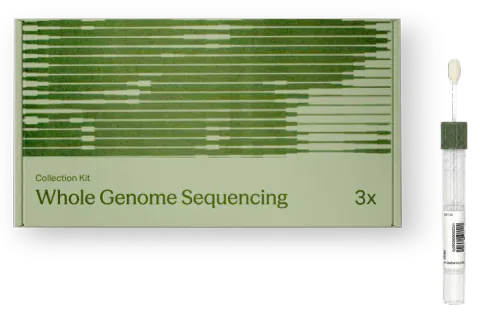
Whole Genome Sequencing Test Kit, 3x
View current details, availability, and member pricing.

Comprehensive Metabolic Panel (CMP)
A 14-marker snapshot of kidney function, liver function, electrolytes, and blood sugar in one draw.
Complete Blood Count (CBC) with Differential and Platelet Count Test
A broad screen of red cells, white cells, and platelets that anchors most checkups.
The standard cholesterol workup for cardiovascular risk, and the baseline for tracking diet, exercise, or statin response.