
3x vs 30x Whole-Genome Sequencing: Which One Should You Choose?
Compare 3x and 30x whole-genome sequencing, including what sequencing depth means, what each depth is best for, and how to choose the right Mito Health genome test.
- Published
- August 10, 2026
- Read time
- 5 min read

Table of contents
Choose 3x whole-genome sequencing if you mainly want to explore ancestry, traits, polygenic scores, and other common-variant patterns. Choose 30x if you want stronger confidence for rare and pathogenic variants, carrier status, ClinVar-linked findings, or pharmacogenomics.
Both 3x whole-genome sequencing and 30x whole-genome sequencing read across your entire genome. Neither is a fixed genotyping array that checks only a preset list of sites. The difference is how many times each position in your genome is read on average. More depth generally provides more confidence, especially for rare variants.
The Short Version
| Question | 3x whole-genome sequencing | 30x whole-genome sequencing |
|---|---|---|
| Best for | Exploration, ancestry, traits, polygenic scores, and genome ownership | Health-oriented genome data and higher-confidence variant calls |
| Confident insights | Common variants, polygenic scores, ancestry, and everyday traits | Common-variant insights plus stronger confidence for rare and pathogenic variants |
| Carrier status | Not the preferred depth when carrier-status confidence is the goal | Better fit for carrier-status findings |
| ClinVar-linked findings | Variants may be visible, but not called with the same confidence | Better fit for reviewing ClinVar-linked findings |
| Pharmacogenomics | Not the preferred depth for medication-response genetics | Better fit for pharmacogenomics |
| Practical recommendation | Choose 3x for common-variant exploration | Choose 30x for health-oriented questions that require greater confidence |
What Does 3x or 30x Mean?
The “x” refers to sequencing depth, also called coverage. A 3x result means each position is read about three times on average. A 30x result means each position is read about thirty times on average.
Sequencing technology reads DNA in fragments, then software reconstructs those reads against a reference genome. Individual reads can contain noise, and some regions are harder to map or covered unevenly. Reading a position more times gives the software more evidence to determine whether a variant is present, absent, or uncertain.
Depth matters most when the answer depends on calling a specific rare variant correctly. Common variants are often easier to analyze at lower depth because they are well studied, can be imputed, and may be interpreted across many sites at once. A specific rare or pathogenic variant requires more confidence in an individual call.
What 3x Whole-Genome Sequencing Is Best For
The 3x depth is best suited to common-variant exploration. It can support ancestry, everyday traits, polygenic scores, and broad exploration of your DNA.
It also gives you a whole-genome file rather than results from a fixed genotyping array. Arrays check a selected set of sites. Whole-genome sequencing reads across the genome itself, so a 3x file can provide a broader foundation for exploration and future reanalysis.
The tradeoff is confidence in rarer findings. Rare variants may be visible at 3x, but they are not called with the same confidence as they are at 30x. Choose a higher depth if rare-variant confidence, carrier status, or pharmacogenomics is central to your reason for sequencing.
What 30x Whole-Genome Sequencing Is Best For
The 30x depth is better suited to health-oriented questions that require greater confidence. It supports the common-variant insights available from 3x while providing more evidence for rare and pathogenic variant calls.
This can matter for:
- Carrier-status findings, including information relevant to family planning
- ClinVar-linked findings that may warrant further review
- Pharmacogenomics, where genetic variants can affect medication response, dosing, or side-effect risk
- Health questions that depend on a specific variant rather than a broad polygenic pattern
30x is commonly described as clinical-grade depth, but the sequencing output is still raw data, not a diagnosis or a medical test result. Ask your doctor or a genetic counselor to review a significant finding before using it for diagnosis, treatment, medication, or other medical decisions.
Why Depth Matters More for Health Questions
Broad ancestry patterns, common traits, and polygenic scores often draw on many common variants. One missed or uncertain site may not change the overall pattern.
A rare-variant question can depend on whether one specific position was called correctly. If that variant is associated with carrier status, medication response, or another clinically relevant finding, greater sequencing depth provides more evidence that the signal is real.
This is the main practical difference: 3x is suited to exploring the common-variant layer, while 30x is better suited to questions about specific rare or clinically relevant variants.
Is 3x Better Than a Genotyping Array?
For genome ownership and future reanalysis, 3x whole-genome sequencing offers a broader data layer than a fixed genotyping array.
A genotyping array checks selected sites. If a site was not included on the chip, the array did not directly measure it. Whole-genome sequencing reads across the genome, although a 3x read is lighter and less confident for rare findings than a 30x read.
The right choice still depends on your goal. An array may be enough for basic ancestry or trait reports. Choose 3x if you want a whole-genome file for common-variant exploration and future reanalysis. Choose 30x if stronger confidence for health-oriented interpretation is important to you.
What Both Depths Have in Common
Both Mito options read across your whole genome. Both are designed to provide downloadable genomic files that you can keep and revisit as analysis tools and scientific knowledge change.
Neither depth should be used alone for diagnosis, treatment, or medication decisions. The extra reads in 30x improve confidence in the sequencing data, but they do not replace appropriate clinical interpretation.
How to Choose Between 3x and 30x
Start with the questions you want the data to help answer:
- Choose 3x if your priorities are ancestry, traits, polygenic scores, common variants, and general exploration.
- Choose 30x if your priorities include rare or pathogenic variants, carrier status, ClinVar-linked findings, or pharmacogenomics.
If you are unsure, ask whether you would be disappointed if the test could not confidently answer a rare-variant, carrier-status, or pharmacogenomic question. If so, 30x is the better fit. If not, 3x provides a whole-genome starting point for common-variant exploration.
Compare Mito’s Whole-Genome Sequencing Options
Review the product pages for details and purchase options:
- 3x whole-genome sequencing: suited to ancestry, traits, polygenic scores, common variants, and personal exploration.
- 30x whole-genome sequencing: suited to greater confidence in rare and pathogenic variants, carrier status, ClinVar-linked findings, and pharmacogenomics.
References
Popular lab tests
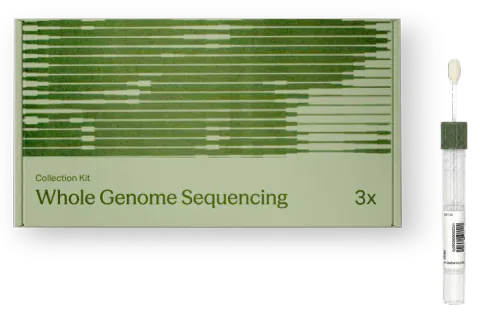
Whole Genome Sequencing Test Kit, 3x
View current details, availability, and member pricing.

Comprehensive Metabolic Panel (CMP)
A 14-marker snapshot of kidney function, liver function, electrolytes, and blood sugar in one draw.
Complete Blood Count (CBC) with Differential and Platelet Count Test
A broad screen of red cells, white cells, and platelets that anchors most checkups.
The standard cholesterol workup for cardiovascular risk, and the baseline for tracking diet, exercise, or statin response.