
Does a Standard Blood Test Detect CHIP? CBC vs. CH Sequencing
A routine complete blood count cannot detect clonal hematopoiesis. Finding a low-frequency somatic clone requires targeted CH sequencing, which reads specific genes down to a very low variant allele frequency.
- Published
- August 27, 2026
- Read time
- 7 min read
- Medically reviewed by
-
 Rhonda Collins, FNP-C

Table of contents
A standard complete blood count (CBC) does not detect clonal hematopoiesis, and it is not designed to. A CBC counts and sizes your blood cells. Clonal hematopoiesis is a low-frequency mutation hiding inside otherwise normal-looking cells, so a person can have entirely normal CBC results and still carry a clone. Detecting clonal hematopoiesis, sometimes called CHIP, requires a different kind of test: targeted next-generation sequencing that reads specific genes down to a very low variant allele frequency. The two tests answer different questions, and one cannot substitute for the other. Neither is a diagnosis, and clonal hematopoiesis testing in particular is a risk signal that a clinician interprets in full context, not a guideline-endorsed screening test for everyone.
Why does a CBC miss clonal hematopoiesis?
A complete blood count measures how many red cells, white cells, and platelets you have, along with their size and other indices. It is a census. It tells you whether the population of cells looks normal in number and shape, which is why it is the right first test for anemia, infection, and many blood disorders.
Clonal hematopoiesis is invisible to a census because the mutated cells usually look and function normally enough to be counted like any others. The change is in the DNA of a subset of cells, not in their count or size. Early on, a clone might make up only a small percentage of your blood cells, and those cells still register on a CBC as ordinary cells. To find the clone you have to read the genetic letters inside the cells and spot the specific mutation, which a CBC never does. That is why normal blood counts are actually part of the definition of CHIP: a measurable clone in someone whose counts are still normal.
How is CH sequencing different from a CBC?
CH sequencing uses targeted next-generation sequencing (NGS) to read a defined set of genes and look for somatic mutations, the kind acquired by blood cells during life. Mito offers CardioHemeRISK, a prescription-only sequencing test that reads 15 genes associated with clonal hematopoiesis and myeloid conditions and reports mutations down to a limit of detection of 0.05 percent variant allele frequency (VAF) for single-nucleotide variants and small insertions or deletions. VAF is the fraction of DNA copies at a position that carry the mutation, so a 0.05 percent limit means the test can flag a clone present in a very small share of cells.
The published analytical performance for CardioHemeRISK, measured against commercial genomic DNA standards, is a specificity above 99 percent and sensitivity above 92 percent for single-nucleotide variants, and a specificity above 99 percent and sensitivity above 91 percent for insertions and deletions. Those are laboratory-standard figures, and real-world detection still depends on clone size and biology.
Instead of returning a raw mutation list, CardioHemeRISK summarizes the finding as a CardioHemeRISK score, built from the highest-VAF variant plus the risk conferred by the specific variants present. The score exists because a clone’s size and identity are what drive its associated risk, and neither is something a CBC can measure.
CBC vs. CH sequencing: what each test answers
Feature | Complete blood count (CBC) | CH sequencing (e.g. CardioHemeRISK) |
|---|---|---|
What it measures | The number, size, and proportion of blood cells | Somatic DNA mutations in targeted blood-cell genes |
Method | Automated cell counting | Targeted next-generation sequencing |
Detects clonal hematopoiesis? | No | Yes, that is its purpose |
Sensitivity to a small clone | None; counts can be fully normal | Down to 0.05% VAF (SNVs and indels) |
Question it answers | Are my blood-cell counts normal right now? | Do I carry an age-related clone linked to heart and blood-cancer risk? |
Availability | Routine, widely ordered | Prescription-only, not a guideline population screen |
Comparison of a routine complete blood count and CH sequencing. Analytical performance figures are for CardioHemeRISK against commercial genomic DNA standards; VAF is variant allele frequency. Neither test is a diagnosis on its own.
The table makes the relationship clear. These are complementary tools, not competitors. A CBC is the workhorse for everyday blood questions and belongs in most routine bloodwork. CH sequencing answers a narrow, specialized question that a CBC structurally cannot reach.
What does each test actually tell you?
A CBC tells you about the present state of your blood: whether you are anemic, whether white cells or platelets are off, whether cell size hints at a nutrient issue. Those answers guide immediate, concrete next steps.
CH sequencing tells you about a risk signal, not a current illness. A detected clone is associated in observational cohorts with a higher risk of heart attack, stroke, and blood cancer, with the strongest associations seen for large clones at a VAF above 10 percent (Jaiswal S et al., New England Journal of Medicine 2014;371:2488 and 2017;377:111; Genovese G et al., New England Journal of Medicine 2014;371:2477). Those are associations, and association does not prove causation. Clonal hematopoiesis is an age- and lifestyle-related inflammatory process that grows more common each decade past 40 and is seen independent of ancestry (Jaiswal S and Ebert BL, Science 2019;366:eaan4673). So the CBC answers “how is my blood today,” while CH sequencing answers “do I carry an age-related clone that shifts my long-term risk.”
When is CH sequencing worth considering?
CH sequencing is a targeted test for a targeted question, not a universal add-on. It tends to be most relevant for (Jakubek YA et al., Translational Research 2023;255:171):
- Healthy adults roughly 40 to 80, where clones become more common with each decade.
- Cancer survivors previously treated with chemotherapy or radiation.
- People with a history of atherosclerotic disease or cardiovascular risk factors such as family history, high blood pressure, and high cholesterol.
Even within these groups, CH sequencing is a personal decision made with a clinician, because no major guideline endorses it as a population screening test. It is one input into a comprehensive, individualized risk assessment. A related caveat: in adults 80 and older, one study found that the presence of clonal hematopoiesis was not associated with higher mortality (van Zeventer IA et al., Blood Advances 2021;5(8):2115), so age and context change what a result means.
How Mito handles both
You do not have to choose between the two. Mito can order a routine CBC as part of comprehensive bloodwork and, when appropriate, CardioHemeRISK for the CH-sequencing question. CardioHemeRISK is $899.64 ($642.60 for Mito members), HSA/FSA eligible, and is ordered through Mito’s telehealth partner: the partner reviews your request, orders the test if it is appropriate, and mobile phlebotomy collects the sample at your home or workplace, so there is no lab visit to schedule.
Keeping both under one roof is the point. A CBC and a CH score read very differently in isolation, but together with the rest of your Mito bloodwork they build a fuller picture. You can ask follow-up questions through Mito Concierge and book a 1:1 consultation to interpret what a clone, or its absence, should mean for you. Not sure where to begin? The Mito quiz helps map out a starting point.
Frequently asked questions
Will my annual physical bloodwork catch CHIP? Not on its own. A standard physical usually includes a CBC, which counts blood cells and cannot detect a low-frequency somatic mutation. CHIP is defined by a measurable clone in someone whose blood counts are still normal.
Can an abnormal CBC be a sign of clonal hematopoiesis? By definition CHIP occurs with normal blood counts. Persistent unexplained CBC abnormalities are a reason to see a clinician, but they are a different situation and are evaluated on their own merits.
How low a clone can CH sequencing detect? CardioHemeRISK reports single-nucleotide variants and small insertions or deletions down to a 0.05 percent variant allele frequency limit of detection, measured against commercial genomic DNA standards.
Is CH sequencing a genetic test I can inherit results from? No. It measures somatic mutations acquired by blood cells during life, not inherited germline genes. It does not assess inherited risk and is not a substitute for genetic counseling.
Do I need a CBC if I get CH sequencing? They answer different questions, so one does not replace the other. A CBC remains the routine test for everyday blood-count questions.
Related reading
- What Is Clonal Hematopoiesis (CHIP)?
- How to Get Tested for Clonal Hematopoiesis (CHIP) and What It Costs
- Clonal Hematopoiesis (CHIP): The Complete Guide
- CHIP Testing vs. Standard Cardiovascular Risk Assessment
Medical disclaimer
This article is for informational purposes only. It does not diagnose any condition and does not replace medical care. CH sequencing, including CardioHemeRISK, is a prescription-only laboratory-developed test that is not FDA-cleared. It is a screening signal, not a diagnosis, and it is not a guideline-endorsed population screening test. The risk figures cited here are observational associations, and association does not prove causation. A CBC and CH sequencing answer different questions, and results from either should be interpreted by a qualified clinician in the context of your symptoms, history, examination, and other testing.
Popular lab tests
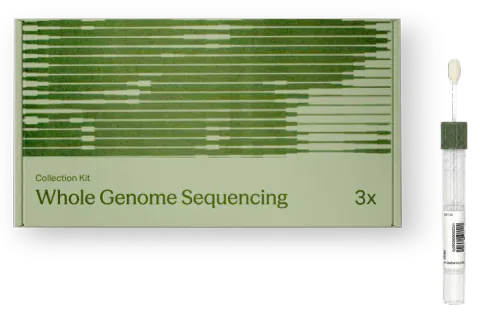
Whole Genome Sequencing Test Kit, 3x
View current details, availability, and member pricing.
Comprehensive Metabolic Panel (CMP)
A 14-marker snapshot of kidney function, liver function, electrolytes, and blood sugar in one draw.
Complete Blood Count (CBC) with Differential and Platelet Count Test
A broad screen of red cells, white cells, and platelets that anchors most checkups.
The standard cholesterol workup for cardiovascular risk, and the baseline for tracking diet, exercise, or statin response.