
Introducing our Care Team Lead: Rhonda Collins. Patient-first care, built for the long run.
Rhonda Collins is joining Mito as our Care Team Lead. After 15+ years in nursing across cardiac ICU, primary care, and dermatology, she's bringing a patient-first, biomarker-driven approach to preventative care. We sat down with her to talk about what changes, what doesn't, and how she thinks about helping clients build a health plan that actually sticks.
- Published
- May 1, 2026
- Read time
- 8 min read

By Rhonda Collins , Board-certified Family Nurse Practitioner
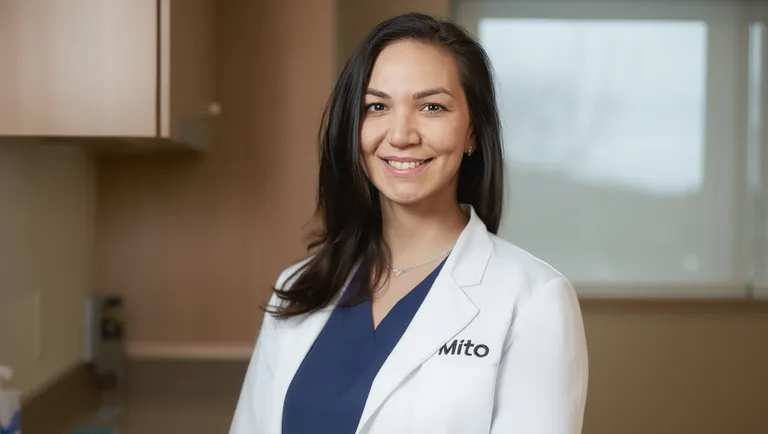
Table of contents
Today we’re announcing that Rhonda Collins is joining Mito Health as our Care Team Lead.
Rhonda brings more than 15 years of nursing experience across adult and pediatric cardiac ICU, primary care across the lifespan, dermatology, and aesthetic medicine. She’s been a trusted part of the Mito care team lead, and as our client base has grown, so has her role. We sat down with her to talk about what the Care Team Lead role means in practice, what nursing brings to longevity care, and the practical steps she’d recommend to anyone serious about their healthspan.
Tell us about yourself! How did you get started in nursing and preventative health?
I came up through bedside nursing, in some of the most acute environments you can work in: cardiac ICU, both adult and pediatric. That kind of work changes how you think about health. You see what a missed decade of preventative care actually costs a person and the people who love them. You also see how much of it was avoidable.
After about a decade at the bedside, I moved toward earlier-stage preventative care so I could meet people earlier in the story. Primary care, instead of crisis care. From there I moved into dermatology and aesthetic medicine, which sounds like a pivot but really isn’t. Skin is the most visible biomarker we have. The same things that drive cardiovascular disease and metabolic dysfunction (inflammation, sleep, nutrition, stress) show up on the face and the body long before they show up in a hospital.
A lot of what I do, in any setting, is the same. Listen. Look at the data. Connect the dots that the patient hasn’t been given the chance to connect.
That’s what drew me to Mito. The work is finally set up to do the connecting at the front of the journey, not the back.
About Mito Health
Could you sum up your role as Care Team Lead in one sentence?
I’m the care team lead on your team. The person making sure the panel, the analysis, and the plan you walk away with actually map to the life you’re trying to live.
What does nursing bring to longevity care that often gets missed?
Care teams and nurses are trained differently, on purpose. The medical model is excellent at diagnosis and intervention. The nursing model is built around the whole person: what they can sustain, what they’re afraid of, what’s getting in the way at home, what trade-offs they’re already making. Both matter. Longevity is a long game, and a long game is won on adherence, not just prescription.
The best plan in the world doesn’t work if it doesn’t fit into your life. My job as Care Team Lead is to make sure ours does.
That’s the lens I bring to every Mito review. Our care team lead sets the quality bar. I make sure the recommendations land in a way you can actually carry.
What is the top takeaway clients gain after a Mito screening?
Permission to focus.
Most people I speak with feel vaguely guilty about their health. They’ve read the same articles, seen the same TikToks, heard the same advice from the same five podcasters, and they’re trying to do all of it. It doesn’t work. It’s exhausting and it’s not personalized.
A Mito panel takes that noise and turns it into a short list. Two or three things that are actually moving the needle for your body, right now. That’s the gift. Not more things to do; fewer, better things to do.
How does Mito’s approach feel different from a typical clinic visit?
Time, mostly.
In a typical primary care visit, you have maybe 12 to 15 minutes with a care team lead. By the time you’ve covered the reason for the visit and the standard screening questions, there’s no room left to talk about how you actually feel, how you’re sleeping, what your training looks like, what you eat, what your stress is doing. Preventative medicine lives in that exact conversation, and that conversation has been quietly squeezed out of the system.
At Mito, the panel does the heavy lifting up front, so by the time we talk, we’re not starting from zero. We already know what your blood says. The conversation can be about you.
That’s a completely different experience for people. It’s the first time many of them have had a care team lead actually sit with the data and walk through what it means.
How does AI fit into the work you do?
It speeds things up without taking the care team lead out of the loop. AI helps us synthesize a panel: connect a marker over here to a pattern over there, surface the things a care team lead should look at first. But the recommendations that go to a client are reviewed by a human care team lead, every time. That’s not changing.
What AI does buy us is consistency at scale. Every client gets the same depth of analysis, regardless of when they come in or who they see. That’s something the traditional system has never been able to deliver, and as Care Team Lead, it’s the part of this job I’m most excited about.
On Health and Preventative Care
Why do you think the standard healthcare system isn’t doing enough for preventative care?
Because it isn’t paid to. The economics of most healthcare systems, including the U.S., reward treating disease, not preventing it. A 30-minute conversation about sleep, nutrition, and stress doesn’t have a billing code that matches its value. So it gets cut.
That’s not a critique of the people inside the system. The teams I trained with care deeply. They’re working inside a model that doesn’t give them the time, the data, or the follow-up tools they need to do real preventative work.
Mito exists in the space the standard system has had to give up. We’re adding the preventative layer that’s been missing.
What’s the most common pattern you see in client labs that surprises people?
Inflammation, by a wide margin. People come in worried about cholesterol or testosterone, and we end up having a conversation about hs-CRP, ferritin, and what their body is quietly fighting on a daily basis.
Inflammation is the through-line. It’s tied to cardiovascular risk, metabolic health, sleep, mood, even skin. And it’s almost always modifiable: sleep, training, alcohol, ultra-processed food, dental health, stress. None of it glamorous. All of it powerful.
For someone just starting their preventative health journey, where should they begin?
Get a baseline. You can’t manage what you don’t measure, and you can’t tell whether anything you change is actually working without numbers to compare it to.
After that, pick one thing. Not five. The single most common reason people fail at this is taking on too much at once. Sleep is usually the highest-leverage place to start, because almost every other system in the body (hormones, glucose regulation, recovery, mood, immune function) runs through it. Fix sleep first, then move down the list.
If someone could only do one thing to improve their healthspan, what would you suggest?
Move every day. Not necessarily train every day. Move. Walk after meals. Carry your own groceries. Take the stairs. Lift something heavy a few times a week. The data on muscle mass, VO2 max, and longevity is overwhelming and it doesn’t require a perfect program to start showing up.
The biggest predictor of how well you’ll age isn’t your weight on a scale. It’s whether you’re still strong, still stable, and still moving in your seventies and eighties.
What’s the most common misconception you hear about preventative health?
That it’s complicated. Or expensive. Or only for biohackers.
The fundamentals are unglamorous and they’re the same fundamentals my grandmother could have told you. Sleep enough. Move daily. Eat mostly real food. Don’t smoke. Drink less than you think you should. Stay connected to people you love. Get screened for the things that are screenable.
What’s changed is that we can now measure the impact of those choices on your body, with much more precision, much earlier. That’s what longevity science has actually unlocked. Not new behaviors. Better feedback on the old ones.
In closing
Taking on the Care Team Lead role at Mito is a privilege. Most of my career has been spent in systems that were designed to catch people after something had already gone wrong. This is the first time I’ve been part of something built the other way around: to find the signal years earlier, when there’s still time to do something with it.
If you’ve been on the fence, my honest advice is the same advice I’d give my own family: get the baseline. You don’t have to commit to a perfect plan. You just have to stop guessing.
Sign up for our flagship package to get started, and I’ll see you in the review.
Related Reads
Popular lab tests

Video consult with your Care Team
View current details, availability, and member pricing.
Comprehensive Metabolic Panel (CMP)
A 14-marker snapshot of kidney function, liver function, electrolytes, and blood sugar in one draw.
Complete Blood Count (CBC) with Differential and Platelet Count Test
A broad screen of red cells, white cells, and platelets that anchors most checkups.
The standard cholesterol workup for cardiovascular risk, and the baseline for tracking diet, exercise, or statin response.